Launch Your Paid Indie Hacker Newsletter: From 0 to $3K MRR in 8 Weeks
Launch a paid indie hacker newsletter that behaves like a product: validated niche, measurable funnels, repeatable issue production, and predictable monetization. In 8 weeks, you'll go from idea to revenue using a dual-tier model (free + paid), a sponsor outreach pipeline, and a writing system that produces 16 conversion-oriented issues without relying on inspiration.
You've spent years building technical skills that make other people rich, while your own side projects collect dust at $200/month. Most indie hackers fail because they pick the wrong monetization model--newsletters are different: they require no code, compound faster than blogs, and can hit $3K MRR while you still have your day job. This course shows you the exact 8-week system I used to go from 0 subscribers to a paid newsletter generating consistent revenue, without burning out or becoming a full-time content machine.
What Students Say
Hear from learners who have completed this course:
Tomás R.
Freelance Product Designer (SaaS)
I’d been “thinking about” a paid newsletter for a year but never picked a niche. Section 1’s validation framework (using fast data checks and competitor/keyword triangulation) pushed me to narrow from “design + startups” to “UX teardown notes for B2B onboarding flows.” That specificity made the Offer Design + Newsletter Economics section actually usable—I set a dual-tier model with a $0 free teardown and a $12/mo paid deep-dive with templates. The Minimum Viable Stack setup in Section 3 (tracking links + a simple funnel dashboard) showed me exactly where conversions were leaking. The biggest win was Section 4’s 16-issue sprint system: I shipped consistently for the first time (no “waiting for inspiration”). In 8 weeks I went from 0 to 312 free subscribers, 41 paid, and $1,180 MRR—plus I’ve landed two design consulting leads directly from paid readers. Rating: 5/5
Read more
Adaeze O.
Growth Marketer at a Fintech Startup
I took this course because I wanted a channel I could own outside of paid ads, and it ended up becoming a repeatable growth asset. The Dual-Funnel Acquisition section (Section 5) was the turning point: I implemented the exact free-to-paid conversion path with a lead magnet issue, a 5-email onboarding sequence, and a clear “why paid” moment by issue #3. Section 3’s tracking guidance helped me instrument the whole thing—UTMs, referral source tracking, and a weekly metrics review—so I stopped guessing and started iterating. I also used the Launch and Monetization Sprint plan (Section 7) like a checklist; it kept the launch from becoming a messy “big bang.” Result: my newsletter hit 1,050 free subs in two months, and I converted 67 to paid at $10/mo ($670 MRR). More importantly for my day job, I repurposed the weekly issue template to ship faster internal growth memos and improved our campaign reporting cadence. Rating: 5/5
Read more
Fatima A.
Data Analyst transitioning to Indie Maker
I’m technical but not a natural writer, so I needed a system. Section 4’s conversion-oriented issue structure (hook, proof, payoff, CTA) and the 16-issue sprint removed the intimidation factor—I wrote my first 10 issues in a single month by following the outline and reusing “modules” instead of starting from scratch each time. The course’s Offer Design and Economics section (Section 2) helped me price rationally: I chose $9/mo paid with an annual option and built a simple revenue model so I could see what 50/100/200 paid subscribers would actually mean. The sponsorship system (Section 6) was unexpectedly valuable: I created a one-page rate card, a short outreach sequence, and a fulfillment checklist so sponsors didn’t feel risky to manage. In week 7 I closed my first sponsor at $250 and two weeks later another at $350—on a list under 900. I’m now at 28 paid subscribers ($252 MRR) plus $600 in sponsorships, and I finally feel like my newsletter is a product with predictable inputs, not a creative hobby. Rating: 5/5
Read more
Course Overview
Launch a paid indie hacker newsletter that behaves like a product: validated niche, measurable funnels, repeatable issue production, and predictable monetization. In 8 weeks, you'll go from idea to revenue using a dual-tier model (free + paid), a sponsor outreach pipeline, and a writing system that produces 16 conversion-oriented issues without relying on inspiration.
Section 1: Validate a Profitable Sub-Niche (Fast, Data-Driven)
You'll identify a narrow, monetizable angle inside the maker economy and validate it with lightweight research, competitive teardown, and direct audience signals before building anything substantial.
Learning Outcomes:
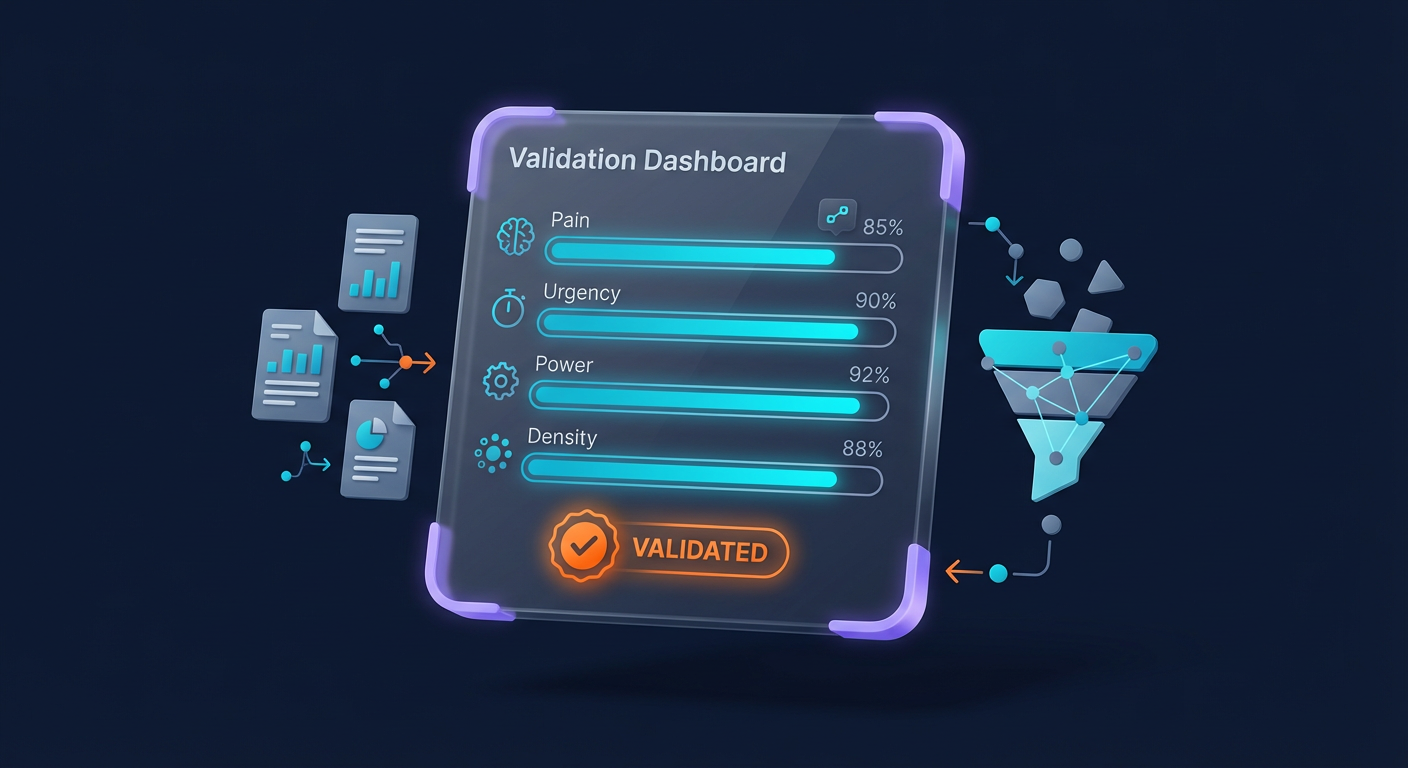
- Select a sub-niche with provable willingness to pay using a simple scoring model (pain, urgency, spending power, audience density).
- Produce a one-page positioning brief: target reader, promise, differentiation, and "why subscribe" statement.
- Validate demand using 3 quick tests (survey, landing page, and outreach) with clear go/no-go thresholds.
Most indie hackers fail not because they lack the technical skill to build, but because they build the wrong thing. They invest six months of nights and weekends into a "micro-SaaS" or content platform, only to discover that no one cares enough to pull out a credit card.
As a technical professional, you likely treat product development as an engineering problem. You should treat market selection the same way. Before you write a single line of content or code, you must debug your niche selection.
This section provides a systematic, data-driven framework to identify a sub-niche with high revenue potential. We are moving away from "follow your passion" and toward "follow the friction."
The P.U.S.D. Scoring Model
To reach $3K+ MRR quickly, you cannot target broad categories like "productivity" or "web development." These markets are saturated, and the willingness to pay is low because the information is commoditized. Instead, you need a sub-niche where specific problems cost money to solve.
We evaluate potential niches using the P.U.S.D. Model. Rank your ideas on a scale of 1-5 for each factor.
| Factor | Definition | Low Score (1-2) | High Score (4-5) |
|---|---|---|---|
| Pain | How acute is the problem? | "It would be nice to know this." | "I am losing money/time daily without this." |
| Urgency | How soon does it need solving? | "I'll learn it someday." | "I have a deadline/audit next week." |
| Spending Power | Who holds the credit card? | Students, hobbyists, B2C. | Businesses, freelancers, consultants (B2B). |
| Density | Is the audience easy to find? | Scattered individuals. | Congregates in specific subreddits, slacks, hashtags. |
Key Insight: A "B2B" newsletter does not necessarily mean selling to Fortune 500s. It means selling to people who use the information to make money. A freelancer paying $15/month for a newsletter that helps them land one $2,000 client sees your subscription as an investment, not an expense.
Example Calculation
Idea A: A newsletter about general JavaScript tips.
- Pain: 2 (Google is free)
- Urgency: 1 (Always learning)
- Spending Power: 2 (Junior devs/Students)
- Density: 5 (Everywhere)
- Total Score: 10/20 (FAIL)
Idea B: AWS Cost Optimization for SaaS CTOs.
- Pain: 5 (AWS bills hurt margins directly)
- Urgency: 4 (Monthly billing cycle)
- Spending Power: 5 (Company card, high ROI)
- Density: 3 (Niche communities, specific Twitter circles)
- Total Score: 17/20 (PASS)
Your goal is to find an intersection with a score of 16 or higher.
The One-Page Positioning Brief
Once you have a high-scoring topic, you must define the product positioning. This is not a business plan; it is a compiled set of variables that defines your Minimum Viable Newsletter. This document prevents scope creep and clarifies your value proposition.
Create a document with exactly these four fields:
1. The Target Reader (The "Who")
Be hyper-specific. "Developers" is too broad. "Senior Python Developers moving into Machine Learning" is perfect. You are looking for a specific professional transition or friction point.
2. The Promise (The "Outcome")
What is the specific transformation? Avoid vague promises like "stay up to date."
- Bad: "I help you learn design."
- Good: "I provide copy-paste UI component code for backend developers who hate CSS, saving them 5 hours per project."
3. The Anti-Positioning (The "differentiation")
Explicitly state what you are not doing. This helps you ignore irrelevant feedback.
- "We do not cover general tech news."
- "We do not focus on beginner tutorials."
4. The "Why Subscribe" Statement
This is your elevator pitch for the paid tier.
- "Subscribers get the raw dataset and the scraping script, not just the analysis."
Pro Tip: The most lucrative newsletters often sell "assets" rather than just "content." If your newsletter provides templates, scripts, datasets, or curation that saves 10+ hours of research, the decision to subscribe becomes a math problem (ROI) rather than a preference problem.
The 3-Step Validation Sprint
You have a hypothesis. Now you need data. Do not build a website yet. Do not write the first issue yet. You are going to run a 48-hour validation sprint to prove that strangers are interested in this value proposition.
Step 1: The "Smoke Test" Landing Page (Time: 2 Hours)
Use a tool like Carrd, ConvertKit, or a simple HTML template. You need a single page containing:
- Headline: Your "Promise" from the brief.
- Sub-headline: addressing the "Pain."
- Call to Action: "Join the waitlist" or "Get the first issue."
- Social Proof (Optional): "Join 50+ engineers" (if true).
Do not spend time on logo design or branding. If the value proposition is strong enough, the design does not matter at this stage.
Step 2: Signal Mining & Distribution (Time: 3 Hours)
You need to drive traffic to this page without paid ads. Go to where your "Density" score indicated your audience lives.
- Hacker News / Reddit: Post a "Show HN" or discussion thread. Do not just self-promote. Ask a question related to the pain point and link your solution in the comments or bio.
- Cold DMs: Identify 20 people on Twitter/LinkedIn who fit your "Target Reader" profile perfectly. Send a non-salesy DM:
- "Hey [Name], I'm building a resource for [Target Role] to solve [Specific Pain]. I'm trying to validate if this is actually a problem worth solving. Would you mind checking this one-pager and telling me if it's stupid? No sales pitch."
Step 3: The Go/No-Go Analysis
After 48 hours and roughly 50-100 unique visitors, analyze the metrics.
The Thresholds:
| Metric | Fail (<) | Marginal (Caution) | Success (>) |
|---|---|---|---|
| Visitor Conversion Rate | < 5% | 5% - 15% | 15%+ |
| DM Response Rate | < 10% | 10% - 25% | 25%+ |
| Waitlist Count | < 10 | 10 - 25 | 25+ |
If you hit the "Success" numbers, you have validated Interest. If you hit "Marginal," tweak the headline and try one more sprint. If you hit "Fail," return to the P.U.S.D. scoring model and pick a new niche.
Important: High traffic with low conversion is a "false positive." It feels like success because people are clicking, but it proves that while the topic is interesting, your specific solution is not compelling enough to warrant an email exchange. In the creator economy, attention is cheap; permission to email is expensive.
Summary and Next Steps
By following this process, you have stripped the emotion out of the decision. You are not betting your time on a hunch; you are executing on a validated signal. You have a niche with a P.U.S.D. score >16, a clear positioning brief, and a list of 25+ real humans who have raised their hands asking for this solution.
You have solved the "what." In the next section, we will solve the "how."
Coming up in Section 2: The Minimum Viable Stack. We will define the leanest possible technical setup to deliver your newsletter. We will compare Substack vs. Beehiiv vs. Ghost/ConvertKit specifically for technical founders, focusing on API access, ownership of data, and long-term monetization features--ensuring you don't get platform-locked as you scale.
Section 2: Offer Design and Newsletter Economics (Subscriptions + Sponsors)
You'll design the free-to-paid value ladder and build a realistic revenue model that blends sponsorships and recurring subscriptions to reach $3K MRR.
Learning Outcomes:
- Define your free tier job (growth) and paid tier job (retention + revenue) with specific content boundaries.
- Build a pricing and revenue calculator (MRR, churn, LTV, sponsor rate card) to choose targets like 100-200 paid subs at $10-$15.
- Create your newsletter "product spec": issue types, cadence, content pillars, and measurable success metrics.
Most newsletter creators fail because they treat their publication as a blog rather than a product. They write whatever comes to mind, hope an audience builds, and pray that eventually, someone will pay them. As an engineer or product person, you know this "build it and they will come" strategy rarely works in software. It works even less effectively in media.
In this section, we are shifting from validation to architecture. We will design your newsletter with the same rigor you would apply to a technical specification for a SaaS product. We aren't just writing emails; we're building a revenue engine with predictable unit economics.
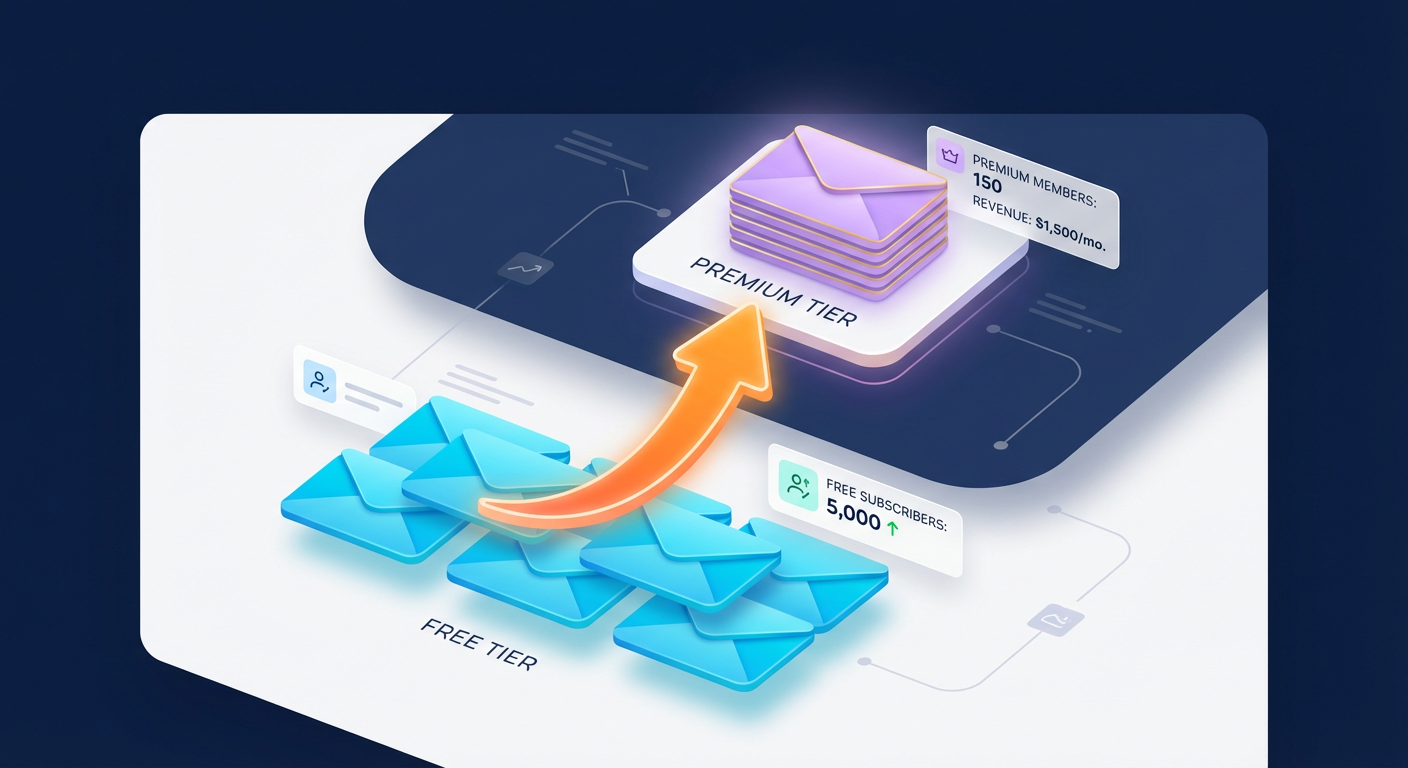
To reach $3K MRR without requiring tens of thousands of subscribers, we will utilize a hybrid revenue model. This leverages the stability of recurring subscriptions (SaaS model) with the high-yield potential of sponsorships (media model).
The Mathematics of $3K MRR
Many indie hackers get stuck on the "volume trap." They calculate that to reach $3K/month at $5/month, they need 600 paying subscribers. If your free-to-paid conversion rate is a standard 5%, you would need an email list of 12,000 people. That's a 12-to-18-month build for most side-hustlers.
Instead, we will target a Hybrid High-Value Model.
By targeting a professional audience (technical professionals, developers, managers), you are solving expensive problems. This allows for higher pricing tiers and attractive sponsorship rates because your audience has high purchasing power.
Here's the breakdown of a realistic path to $3K MRR for a technical newsletter:
| Metric | Volume Model (The Hard Way) | Hybrid High-Value Model (The Smart Way) |
|---|---|---|
| Price Point | $5 / month | $12 / month (or $120/yr) |
| Paid Subs Needed | 600 | 170 |
| Subscription Revenue | $3,000 | $2,040 |
| Sponsorship Revenue | $0 | $960 (4 spots @ $240) |
| Total MRR | $3,000 | $3,000 |
| Required Free List | ~12,000 | ~3,400 |
Key Insight: By increasing your price to $12 (the cost of one lunch) and adding one modest sponsor slot per week, you cut the required audience size by nearly 70%. This turns a two-year slog into a 6-month executable plan.
Defining Content Boundaries: The Free vs. Paid Jobs
To charge $12-$15 per month, your paid product cannot simply be "more of the free stuff." You must clearly distinguish between the "jobs" your content performs.
In the indie hacker space, free content generally solves for Discovery and Breadth, while paid content solves for Implementation and Depth.
The Free Tier Job: Growth & Authority
Your free newsletter exists to grow your top-of-funnel. It must be highly sharable and broad enough to attract new readers.
- Content Focus: Trends, news analysis, high-level strategy, "The What" and "The Why."
- Format: Short essays, curated lists, opinion pieces.
- Goal: Open rates and forwards.
The Paid Tier Job: Retention & ROI
Your paid newsletter is a utility. It exists to save the reader time or make them money. It's the "documentation" for the career or business outcome they want.
- Content Focus: Tutorials, templates, code snippets, SOPs (Standard Operating Procedures), deep-dive case studies, "The How."
- Format: Long-form actionable guides, downloadable resources, database access.
- Goal: Low churn and high LTV (Lifetime Value).
Pro Tip: When designing your paid offer, ask yourself: "Does this asset save my reader 2 hours of work?" If you provide a Notion template for project management or a script for automating AWS backups, the ROI is immediate. That's worth $15/month; a 1,000-word opinion piece is not.
Creating Your Newsletter "Product Spec"
Before writing a single issue, you need a spec sheet. This prevents scope creep and ensures you can deliver consistent value within your 10-15 hour weekly limit.
Build your spec using the following parameters:
1. The Cadence
- Free Edition: Weekly (e.g., Tuesday morning). Consistency builds habit.
- Paid Edition: Bi-weekly or Monthly Deep Dives.
- Controversial take: You do not need to write weekly for paid subscribers. High-value professionals prefer density over frequency. One high-impact asset per month is often valued higher than four mediocre weekly emails that clutter their inbox.
2. The Content Pillars
Select 3 specific pillars you will rotate through to ensure you never face writer's block.
- Example for a "Senior React Developer" Newsletter:
- Pillar A (Technical Deep Dive): dissecting a complex hook or rendering pattern.
- Pillar B (Career Engineering): negotiation, system design interview prep, soft skills.
- Pillar C (Ecosystem Analysis): opinions on new frameworks (Next.js vs Remix).
3. The Asset Library (The "Moat")
To reduce churn, build a static library of assets available only to paid members.
- The Artifact: A Notion board of interview questions, a GitHub repo of starter kits, or a spreadsheet of salary data.
- The Effect: Readers may cancel a subscription to a stream of emails, but they hesitate to lose access to a constantly updated database.
Designing the Revenue Calculator
You need to establish your target metrics immediately. This allows you to work backward to determine your daily required actions.
Step 1: Determine Your Sponsor Rate (CPM) For a general audience, CPM (Cost Per Mille/Thousand) is $25-$40. For a niche technical audience (e.g., "DevOps Engineers"), CPMs range from $60 to $150.
- Conservative Estimate: $50 CPM.
- Formula:
(List Size / 1000) * Open Rate * CPM. - Example: 2,000 subs * 50% open rate = 1,000 impressions. At $60 CPM, that's $60 per ad slot.
Step 2: Calculate Subscription LTV
- Price: $12/month.
- Churn: Aim for <5% monthly.
- LTV: $12 / 0.05 = $240 per customer.
Step 3: The "Freedom Number" Formula To hit $3,000 MRR with a 70/30 split (70% Sub / 30% Ad):
- Subscription Goal: $2,100 MRR. At $12/mo, you need 175 paid subscribers.
- Sponsorship Goal: $900/mo. With 4 issues/mo, that is $225 per issue.
- To command $225/issue at a $60 CPM (based on opens), you need ~3,750 opens per issue.
- With a 50% open rate, you need a total list size of 7,500 free subscribers.
Note: If 7,500 seems high, remember that sponsorship income scales linearly, while subscription income scales exponentially with conversion optimization. Many creators hit $3K MRR with fewer than 3,000 subscribers by focusing heavily on the paid tier value proposition.
What You'll Build On
In this section, we architected the "Product." The rest of the course focuses on the "Build" and the "Sales."
- In Section 3 (Tech Stack): We will implement the specific tools (Substack vs. Beehiiv vs. Ghost) to handle this hybrid gating without writing custom code.
- In Section 4 (Acquisition): We will deploy the "Engineering-as-Marketing" strategy to get your first 1,000 free subscribers.
- In Section 5 (Monetization): We will draft the exact cold emails used to secure those $200+ sponsorship slots.
Conclusion
You now have a product specification and a financial roadmap. You aren't just "starting a newsletter"; you are launching a subscription media business with clear unit economics.
By separating the "Growth Job" (Free) from the "Retention Job" (Paid), you escape the trap of infinite content creation. You can focus on building a compact, high-value asset that respects your time and your audience's intelligence.
In the upcoming full course modules, we move from planning to execution. We will set up your landing pages, automate your welcome sequences, and launch your first issue to a waiting list of eager technical professionals. The roadmap is set; now we build.
Course Details
- Sections8 sections
- Price$9.99