Launch Your Paid Discord Bot Business: From Idea to $5K MRR in 60 Days
Launch a monetized Discord bot business in 60 days using a validation-first roadmap designed for working developers who want revenue, not vanity metrics. You'll identify a painful, underserved server problem, ship a production-ready bot with premium gating and Stripe subscriptions, then execute a targeted launch to reach your first 50-100 paying servers and build a path to $5K MRR.
You've built impressive projects that get GitHub stars but make zero dollars, while watching developers with worse code pull in thousands monthly from simple Discord bots. The difference isn't their technical skills--it's that they know exactly which bots server owners will pay for, how to validate ideas in 48 hours instead of wasting months, and the specific acquisition channels that turn Discord users into paying customers. This course gives you the complete playbook to ship your first profitable bot in 60 days, using the same validation framework that helped 200+ developers hit their first $1K MRR.
What Students Say
Hear from learners who have completed this course:
Tomás R.
Indie Developer (ex-DevOps) building tools for gaming communities
I’ve shipped Discord bots before, but I’d never gotten anyone to pay. Section 2 (“Validation Before Code”) was the wake-up call — I stopped guessing and did the server-owner interviews exactly like the course laid out. That led me to a very specific pain: post-raid scheduling + attendance tracking for small MMO guild servers. Section 3 helped me scope an MVP with a premium hook (multi-event templates + export) and set pricing I wasn’t embarrassed to charge. On the build side, the Section 4 reliability checklist (permissions edge cases + slash command UX) saved me from the usual support nightmare. I implemented premium gating + Stripe subscriptions from Section 5 in a weekend, including usage-based billing for extra event reminders. After following the launch plays in Section 7 (listing + targeted outreach to guild owner communities), I hit 31 paying servers in 6 weeks and crossed $1.2K MRR. The biggest win is I now have a repeatable process instead of “ship and pray.”
Read more
Priya V.
Full-stack Engineer at a fintech, weekend side-project founder
I bought this because I wanted a revenue-driven roadmap, not another “build a bot” tutorial. Section 1’s 60-day plan kept me honest — I literally blocked the weeks on my calendar and used the revenue target checkpoints. The most valuable part was Section 5: setting up Stripe subscriptions correctly with premium gating. I finally understood how to structure plans vs. entitlements, and I used the course’s approach to add a usage-based tier for “extra automations per month.” Section 6 (Ops and Trust) was unexpectedly clutch: I implemented monitoring/alerts and the verification steps so server owners didn’t hesitate to invite the bot. Result: my bot went from flaky hobby project to something I felt confident charging for. I launched to a niche of study/community servers and reached 18 paying servers in the first month at $15–$25/mo, plus fewer support tickets because the permissions + slash command patterns in Section 4 were solid. It’s now doing ~$600 MRR and growing steadily without me being on-call every night.
Read more
Adaeze O.
Community Manager & Analytics Lead for an esports org
I’m not a career developer — I manage Discord communities — but I can code enough to be dangerous. The course made the business side finally click. In Section 2, the “painful problem server owners pay to fix” framework helped me validate demand with other esports admins before I wrote a line of code. I discovered a recurring headache: sponsors wanting clean weekly engagement reports without giving full admin access. Using Section 3, I designed an MVP that converts (free basic stats, paid sponsor-ready PDF exports + scheduled reports). Section 4 walked me through slash commands and permissions so I could keep data access tight. Then Section 7’s outreach playbook (owner communities + specific Reddit angles) got me my first paying servers fast because I wasn’t spamming — I was speaking to a very specific admin pain. Concrete outcome: 42 paying servers in ~8 weeks, averaging $19/mo, and I’m now using the metrics/retention loops from Section 8 to reduce churn (monthly “wins” reports + in-bot prompts to set up automations). This course basically turned what I did for my day job into a product I own.
Read more
Course Overview
Launch a monetized Discord bot business in 60 days using a validation-first roadmap designed for working developers who want revenue, not vanity metrics. You'll identify a painful, underserved server problem, ship a production-ready bot with premium gating and Stripe subscriptions, then execute a targeted launch to reach your first 50-100 paying servers and build a path to $5K MRR.
Section 1: The 60-Day Plan, Quick Wins, and Your Revenue Target
Set up the course operating system: timeline, weekly milestones, success metrics, and a "quick win" bot that runs in a test server within the first sessions to build momentum. You'll also define a realistic MRR target and reverse-engineer the number of paying servers and price points needed to hit it.
Learning Outcomes:
- Translate a $2K-$5K MRR goal into concrete pricing tiers and required paying servers
- Set up a working Discord bot locally and deploy a minimal version to a test server
- Define the key metrics you'll track (activation, retention, conversion, churn) and how they map to revenue
Most developers have a "graveyard" folder on their computer. It is full of half-finished side projects, brilliant SaaS ideas that stalled out, and tools that were fun to build but never made a dime. The problem isn't your code. As a developer, you already have the technical leverage to build products that people need. The problem is the lack of an Operating System for turning code into revenue.
In this course, we are not just writing a bot; we are building a business asset. We are shifting your focus from "how do I code this?" to "how does this function generate MRR (Monthly Recurring Revenue)?"
This first section establishes the foundation. We are going to define the 60-day roadmap, reverse-engineer the math required to hit a $5,000 monthly target, and--because we believe in momentum over theory--we will get a "Hello World" bot live in a test server immediately.
The 60-Day Execution Roadmap
We are compressing a typical startup lifecycle into a 60-day sprint. This timeline is designed to prevent "analysis paralysis" and force you to ship. We divide the timeline into three distinct phases to manage focus and energy.
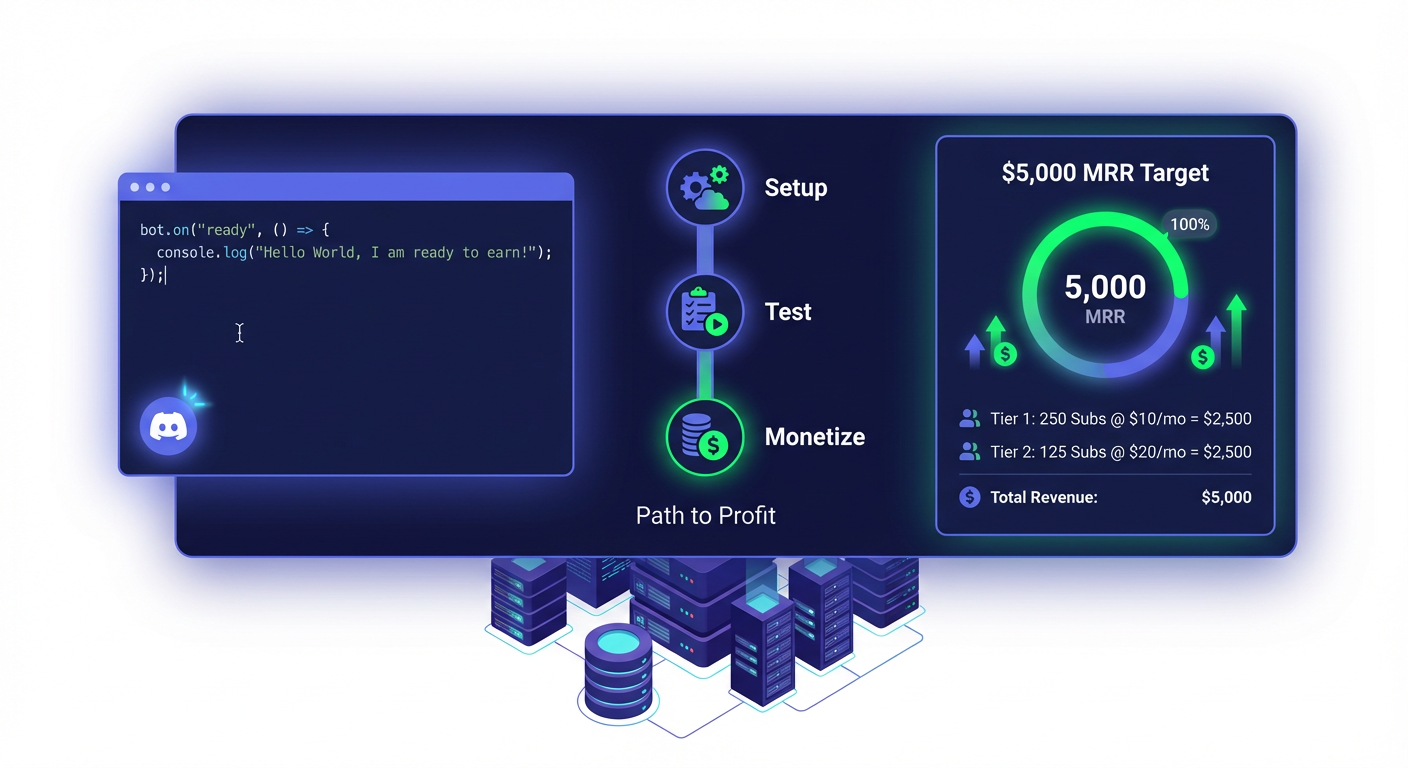
- Phase 1: Validation & Architecture (Days 1-15): Before writing a single line of production code, we validate demand. You will identify a specific problem for a specific type of Discord server (e.g., DAO management, scrim organization for eSports, stock alerts) and confirm server owners are willing to pay for a solution.
- Phase 2: The Build Sprint (Days 16-40): This is deep work. You will build the Minimum Sellable Product (MSP). Unlike an MVP, an MSP is polished enough to charge for immediately. We focus on core functionality, payment webhooks (Stripe/LemonSqueezy), and slash command infrastructure.
- Phase 3: Launch & Growth (Days 41-60): You shift from developer to CTO/CMO. We focus on directory listings (Top.gg), direct outreach to server admins, and optimizing your conversion funnel.
Key Insight: Most developer-entrepreneurs fail because they spend 60 days in Phase 2 and zero days in Phases 1 or 3. They build a solution in search of a problem. In this course, we do not write production code until we know exactly who is buying it.
Reverse-Engineering the $5K Goal
"Making money" is a vague wish. "$5,000 MRR" is an engineering problem we can solve with math. To reach this goal, you need to understand the relationship between your Price Point (ARPU) and your Volume (Paying Servers).
In the Discord ecosystem, you generally have two distinct pricing strategies:
- B2C / Community Bots: Low price ($3-$5/mo), high volume. These are fun bots, RPGs, or leveling systems.
- B2B / Utility Bots: High price ($15-$50/mo), lower volume. These solve expensive problems for server owners running businesses, paid communities, or complex operations.
Let's look at the numbers required to hit $5,000 MRR:
| Model | Price Per Server | Paying Servers Needed | Est. Free Installs Needed (at 2% conversion) |
|---|---|---|---|
| Micro-SaaS | $5 / month | 1,000 | 50,000 |
| Standard Tier | $15 / month | 334 | 16,700 |
| Pro Utility | $49 / month | 102 | 5,100 |
| Enterprise | $99 / month | 51 | 2,550 |
Pro Tip: For a solo developer looking to replace a full-time income, the Pro Utility ($29-$49) tier is often the sweet spot. It is significantly easier to find 100 server owners with a painful business problem than it is to support 50,000 free users just to convert 1,000 of them.
The "Quick Win": Your First Bot Deployment
We are going to break the inertia right now. We won't build the full product today, but we will set up the "skeleton" to verify your development environment works. We will assume you are using Node.js and Discord.js, as this is the industry standard for scalable bots, though the logic applies to Python/Rust as well.
Step 1: The Developer Portal
- Go to the Discord Developer Portal.
- Click New Application and give it a name (e.g., "CourseTestBot").
- Navigate to the Bot tab and click Add Bot.
- Critical Security Step: Disable "Public Bot" for now. Enable "Message Content Intent" if you plan to read messages, though we will primarily use Slash Commands.
- Copy your Token. This is your API key. Never commit this to GitHub.
Step 2: Minimal Local Environment Initialize your project folder and install the necessary library.
mkdir discord-bot-business
cd discord-bot-business
npm init -y
npm install discord.js dotenv
Step 3: The "Pulse Check" Code
Create an index.js file. We aren't making complex commands yet; we just want to see the "Online" green light.
require('dotenv').config();
const { Client, GatewayIntentBits } = require('discord.js');

// Initialize client with minimal intents
const client = new Client({
    intents: [
        GatewayIntentBits.Guilds,
    ]
});

client.once('ready', () => {
    console.log(`✅ Success! Logged in as ${client.user.tag}`);
    console.log(`🚀 Ready to build a business.`);
});

client.login(process.env.DISCORD_TOKEN);
Step 4: The Test Server
Create a fresh Discord server meant for testing. In the Developer Portal, go to OAuth2 > URL Generator. Check bot and applications.commands. Copy the URL, paste it into your browser, and invite the bot to your test server. Run your script (node index.js).
If you see that green light turn on in your Discord sidebar, you have officially moved from "thinking about a bot" to "running a bot."
Defining Metrics That Map to Revenue
As engineers, we love tracking uptime and latency. However, to reach $5K MRR, you need to track business metrics. We will implement logging for these specific KPIs (Key Performance Indicators) later in the course.
- Activation Rate:
- Definition: The percentage of servers that invite your bot and run at least one slash command within 24 hours.
- Why it matters: If a server invites your bot but never uses it, they will never pay.
- Day-30 Retention:
- Definition: The percentage of servers that still have the bot installed 30 days after the invite.
- Industry Benchmark: Good utility bots see >60% retention. Entertainment bots often see <40%.
- Free-to-Paid Conversion:
- Definition: The percentage of active servers that upgrade to a premium tier.
- Target: Aim for 1-3%. If you are below 0.5%, your pricing is wrong or your free tier is too generous.
Key Insight: "Churn" is the silent killer of subscription businesses. If your bot has a 10% monthly churn rate, you have to replace 10% of your customer base every month just to stay flat. We will focus heavily on building features that make your bot "sticky"--hard to remove once integrated into a server's workflow.
What's Next?
You have a roadmap, a revenue target based on real math, and a working bot instance connected to Discord. You are already ahead of 90% of people who "want to start a side hustle" but never open their IDE.
In Section 2, we will tackle the most common failure point: building the wrong thing. We will use a "Pain-Point Sniping" technique to scan Reddit and Discord communities, identifying exactly what features server owners are begging for--and are willing to pay for.
Section 2: Validation Before Code: Find a Painful Problem Server Owners Pay To Fix
Run community-driven research to discover high-demand pain points and validate willingness to pay before building. You'll learn a repeatable system for interviewing server owners, analyzing competitor bots, and selecting a narrow, monetizable niche with clear differentiation.
Learning Outcomes:
- Execute a validation workflow using Discord communities, Reddit, and bot directory research
- Produce a ranked list of pain points with evidence, urgency, and monetization potential
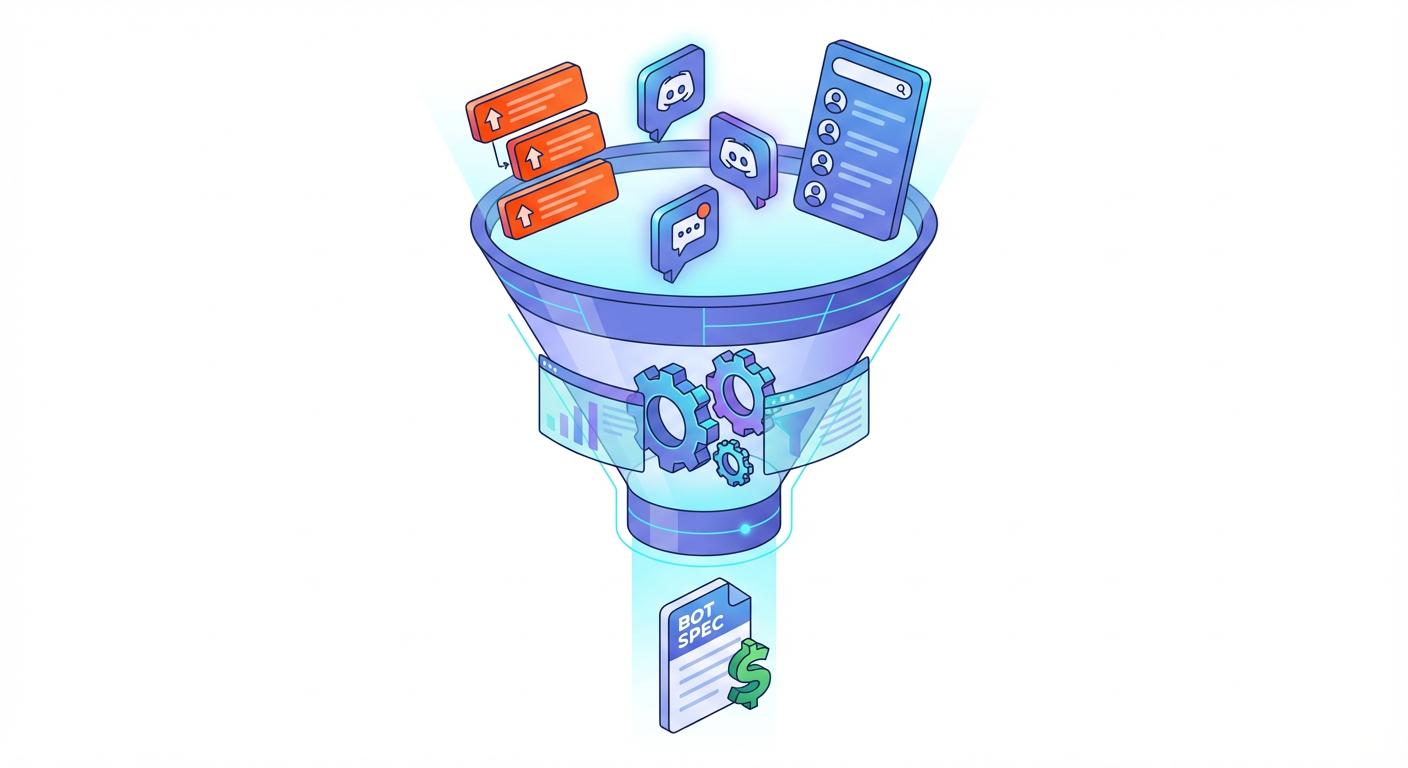
- Write a one-page "bot spec" (target user, job-to-be-done, must-have features, premium hook, pricing hypothesis)
The biggest mistake developers make is opening VS Code too early.
As a developer, your instinct is to build. You have a cool idea for a moderation tool or an economy game, and you immediately start thinking about database schemas, slash command structures, and API latency. It feels productive because you are writing code.
But in the business of Discord bots, code is a liability until you have verified demand. Every line of code you write for a feature nobody wants is technical debt that generates zero revenue.
In this section, we are going to pause the development environment and act as product managers. We will use a "Validation First" workflow to identify a painful problem that server owners are already desperate to solve--so desperate that they are willing to pay for it.
The Hierarchy of Server Owner Pain
Not all problems are created equal. To build a bot that generates $5K MRR, you cannot just build something "fun." You must solve a problem that impacts the server owner's ability to manage or grow their community.
We are looking for Tier 1 Pain Points:
- Risk: "If I don't fix this, my server will get raided or nuked."
- Time: "I spend 10 hours a week manually updating this spreadsheet."
- Growth: "I am losing members because engagement is stale."
If your bot idea is "it plays funny cat noises," that is a hobby. If your bot idea is "it automates the onboarding of paid members so mods don't have to," that is a business.
Step 1: Community Reconnaissance
We will not guess what people want. We will look for the "smoke" that indicates a fire. We will use three primary channels to find evidence of demand.
1. The "Graveyard" Search (Reddit)
Go to subreddits like r/Discord_Bots, r/Discord_UI, and r/Admincraft. We are looking for "Request" posts where the user explicitly mentions a budget.
Use these search operators in Reddit:
subreddit:discord_bots "willing to pay"subreddit:discord_bots "budget""is there a bot that"
Pro Tip: Ignore requests for "custom" bots that are hyper-specific to one server's lore. You are looking for patterns. If you see three different people asking for a "verification bot that connects to XYZ game API" in the last month, you have found a market signal.
2. The Negative Review Audit (Bot Directories)
Go to Top.gg or Discord App Directory. Find the most popular bots in a specific category (e.g., Moderation or RPG). Ignore the 5-star reviews.
Filter for 2-star and 3-star reviews. These are your goldmines. These users generally like the concept of the bot but are frustrated by a specific execution failure. Look for phrases like:
- "Great bot, but it's always offline."
- "Too complicated to set up."
- "I would pay for premium, but the support is nonexistent."
If you can build a stable, user-friendly version of a buggy incumbent, you do not need a "new" idea. You just need better execution.
3. The "Manual Work" Spy
Join 5-10 large Discord servers in a niche you understand (e.g., crypto, competitive gaming, anime art). Watch the #general and #support channels.
Look for manual processes.
- Are mods manually copy-pasting welcome messages?
- Are admins manually updating a leaderboard in a pinned message?
- Are users constantly asking "When is the next event?"
Key Insight: Wherever you see a human doing a robot's job, there is an opportunity to sell a bot.
Step 2: The "Mom Test" Interviews
Once you have a hypothesis (e.g., "Server owners hate manually tracking scrim scores"), you need to verify it with humans.
Do not send a sales pitch. Server owners are naturally skeptical of sales. Instead, frame your outreach as "developer research."
The Outreach Script:
- Context: Find a server owner or head admin.
- The DM: "Hey [Name], I'm a dev researching how competitive servers handle scoring. I noticed you run [Server Name]. I'm not selling anything--just trying to understand how much time this takes you manually? Thanks."
If they reply, your goal is to determine Willingness to Pay (WTP) without asking "Will you buy this?" (because people lie to be nice).
Ask these three questions:
- "How do you currently handle [problem]?"
- "What is the most annoying thing about that process?"
- "Have you tried paying for a solution before? If yes, why didn't it work?"
If they are currently paying for a solution that does not work well, or if they are spending 5+ hours a week doing it manually, you have validated the pain point.
Step 3: Analyzing the Competition
You might find that a bot already exists for your idea. This is good news.
If there are zero competitors, there is likely no market. If there are five competitors, there is a market, and you just need to differentiate. Create a simple comparison table to find your "wedge."
| Feature | Competitor A (Market Leader) | Competitor B (Budget Option) | Your Opportunity (The Wedge) |
|---|---|---|---|
| Uptime | 99% | 85% (Unreliable) | 99.9% (Tiered Architecture) |
| UX/Setup | Complex Dashboard | Text Commands | One-click Slash Commands |
| Pricing | $10/mo (Enterprise focus) | Free | $5/mo (Mid-market focus) |
| Support | Slow/Automated | None | Developer Direct |
Your goal is to find the "Premium Hook"--the one specific feature that the big competitors lock behind an expensive tier or execute poorly, which you can offer as your core value proposition.
The Output: The One-Page Bot Spec
Before moving to Section 3 to set up your environment, you must complete the One-Page Bot Spec. This document is your contract with yourself to prevent scope creep.
Template: The Scrim-Manager Bot Spec
- Target User: Owners of competitive Valorant servers (1k+ members).
- The Pain: Admins spend 6 hours/week manually updating ELO spreadsheets.
- The Job-to-be-Done: Automate score reporting via screenshot parsing.
- Must-Have MVP Features:
/registercommand for teams./reportcommand accepting image attachments.- OCR (Optical Character Recognition) integration to read scores.
- Live leaderboard channel update.
- The Premium Hook: OCR automation. (Free tier requires manual score entry; Premium tier does it automatically).
- Pricing Hypothesis: Free for up to 10 matches/week. $5/mo for unlimited matches.
- Differentiation: Competitors require manual input; we use image recognition to save time.
What You'll Build On
The spec you create here determines your technical stack in the coming sections.
- In Section 4, we will design the database schema specifically to support the data models defined in your "Must-Have Features."
- In Section 6, we will implement Stripe specifically to gate the "Premium Hook" you identified above.
- In Section 7, we will use the "Pain Points" language you discovered during research to write your marketing copy.
If you skip this validation, those future sections will be generic. Nail the spec now.
Summary
You now have a validated problem, a specific target audience, and a specification sheet. You are no longer "messing around" with Discord.js; you are building a product to solve a verified need.
You have likely realized that the technical implementation of things like "OCR integration" or "Premium Gating" is harder than a basic ping-pong bot. That is exactly why this opportunity pays.
In the next section, we will open the terminal. We will set up a professional, scalable development environment that separates you from the hobbyists, ensuring that when you do launch, your bot stays online and scales effortlessly.
This concludes the preview of Section 2.
In the full course, we dive deeper into the "Differentiation Matrix"--a tool for analyzing the top 5 bots in your niche to find technical weaknesses you can exploit. We also provide the exact JSON templates for the Bot Spec that you can drop directly into your project documentation.
Ready to stop guessing and start building for revenue? The complete roadmap awaits in the full course.
Course Details
- Sections8 sections
- Price$9.99