Launch Your Flutter Mobile App Business: From Idea to $5K MRR in 90 Days
Launch a real Flutter app business in 90 days using a validation-first, developer-friendly system designed for people who can build but haven't cracked distribution and monetization. You'll go from niche selection and customer proof to a shipped iOS/Android app with Firebase analytics, subscriptions/ads, App Store/Google Play launch, and an execution plan to reach your first 500 downloads and a clear path toward $5K MRR.
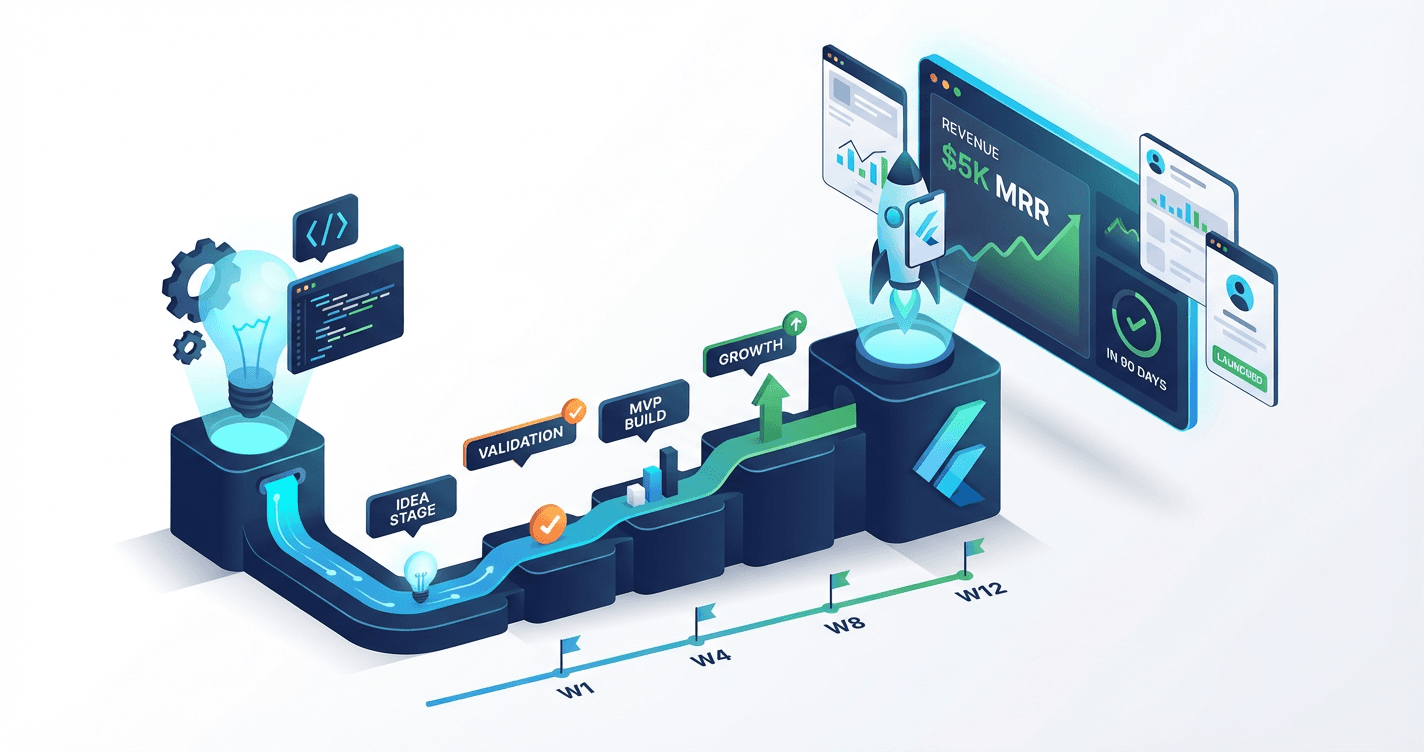
You've spent months building apps that nobody downloads while your salary stays flat and your side project graveyard grows deeper. Meanwhile, developers with half your technical skills are pulling $5K per month from simple Flutter apps because they cracked the code on validation and monetization, not just clean architecture. This course shows you the exact 90-day system to transform your developer skills into your first profitable mobile app business, no marketing degree or startup co-founder required.
What Students Say
Hear from learners who have completed this course:
Tomás R.
Freelance Flutter Developer (Colombia)
I could always build apps, but I kept shipping “nice-to-have” projects that nobody paid for. Section 2 (Niche Discovery) and the market research templates forced me to stop guessing—especially the part about mining App Store reviews and competitor pricing pages. In Section 3, I used the pre-sell script and the “validation calls” checklist to talk to 12 small gym owners and got 6 to commit to a paid beta before I wrote the MVP. Section 4’s opinionated Flutter stack saved me weeks (the exact project structure + onboarding flow patterns were what I needed). Then Section 5 was the real unlock: I implemented RevenueCat subscriptions and Firebase analytics/events exactly as taught, so I could see where users dropped off in onboarding. Within 90 days I launched on both stores and hit 73 paying subscribers at $9.99/mo (~$730 MRR). More importantly, it’s the first time my app revenue is predictable instead of “maybe I’ll get some downloads.”
Read more
Priya V.
Product Manager transitioning into indie app founder (India)
I’m not a full-time developer, so I needed a system that didn’t rely on “just build more features.” Section 1’s 90-day plan broke everything into weekly deliverables and made it realistic alongside my day job. The biggest shift was Section 3: the “pre-sell without feeling like a marketer” approach helped me run a simple landing page + waitlist and send a pre-order email that didn’t sound salesy. When we built the MVP, Section 6 (App Store/Play Store Launch System) was gold. I followed the submission checklist, created the conversion assets (screenshots + a short preview video), and used the ASO framework to rewrite my title/subtitle and keywords. My first launch attempt used to be a black box; this time it was step-by-step. Result: we reached 540 downloads in the first month using the launch loops from Section 7, and our trial-to-paid conversion improved from 6% to 11% after we adjusted pricing and paywall copy using Section 8’s retention/pricing guidance. I’m now at $1.4K MRR with a clear roadmap to scale.
Read more
Adaeze O.
Data Analyst building a wellness app as a side business (Nigeria)
I joined because I could code Flutter basics but had no clue how to instrument an app business. Section 5 (Backend, Analytics, and Monetization Plumbing) was exactly what I needed: I set up Firebase Analytics with custom events for onboarding completion, “first value” action, and paywall views. Seeing that only ~38% of users reached the core feature changed everything—I simplified the onboarding flow from 6 screens to 3. I also implemented ads for free users and a subscription tier via RevenueCat like the course showed, which kept the code clean and made testing pricing way easier. In Section 8, the A/B testing and retention routines helped me run a weekly “metrics review” (DAU/WAU, trial starts, churn) without getting overwhelmed. Concrete results: churn dropped from ~9% monthly to 4.8% after I added the win-back flow and improved the first-week experience, and ARPU increased because I introduced an annual plan with a clearer value breakdown. I’m at 1,900 total downloads and just crossed $620 MRR—small compared to $5K, but it’s the first time my side project behaves like a real business.
Read more
Course Overview
Launch a real Flutter app business in 90 days using a validation-first, developer-friendly system designed for people who can build but haven't cracked distribution and monetization. You'll go from niche selection and customer proof to a shipped iOS/Android app with Firebase analytics, subscriptions/ads, App Store/Google Play launch, and an execution plan to reach your first 500 downloads and a clear path toward $5K MRR.
Section 1: The 90-Day App Business Plan and Validation-First Mindset
You'll set constraints (time, scope, revenue goal) and adopt a validation workflow that prevents months of building with zero users. This section turns your app idea into testable assumptions and a weekly execution plan that fits 10-15 hours/week.
Learning Outcomes:
- Define a realistic 90-day scope, milestones, and success metrics (downloads, activation, conversion, retention, MRR).
- Translate vague ideas into falsifiable hypotheses (problem, audience, willingness-to-pay, acquisition channel).
- Create a weekly execution cadence and "stop/iterate" rules to avoid over-building.
The biggest lie in the software industry is that "if you build it, they will come." As a developer, you have a superpower: you can turn coffee into code and ideas into reality. But that superpower is also your greatest liability.
Most developers stay stuck in the "salary trap" not because they can't build apps, but because they build the wrong apps. They spend six months architecting a perfect clean-code solution with robust error handling and advanced state management, only to launch to silence.
In this course, we are flipping that script. We are moving from a Build-First mindset to a Validation-First mindset.

The 90-Day Hard Stop
Parkinson's Law states that "work expands to fill the time available for its completion." If you give yourself a year to build a side business, it will take a year (or likely never finish). If you give yourself 90 days, you force prioritization.
We are operating on a strict 90-day timeline to reach initial revenue or a "kill" decision. This prevents the zombie project scenario--a repository that you guiltily update every few months but never actually ship.
Here is the high-level architecture of your next 90 days:
| Phase | Duration | Focus | Key Output |
|---|---|---|---|
| 1. Validation | Days 1-30 | Research & Strategy | A verified problem and a waitlist of 50+ interested users. |
| 2. Build (MVP) | Days 31-60 | Coding & Implementation | A functional Flutter app with core features and payment integration. |
| 3. Traction | Days 61-90 | Marketing & Optimization | First 100 paying customers and ASO ranking. |
Key Insight: Your goal for the first 30 days is not to write code. Writing code is comfortable; it's where you feel safe. But writing code before verifying the problem is "premature optimization" of your business model.
Turning Ideas into Falsifiable Hypotheses
In software engineering, you write tests to ensure your code behaves as expected. In business, you must write tests to ensure your market behaves as expected.
A vague idea looks like this: "I want to build a fitness app for dog owners." This is impossible to validate because "fitness app" is too broad and "dog owners" is a demographic, not a market with a specific pain point.
Instead, we use the Scientific Method for Startups. You must translate your idea into a falsifiable hypothesis using this format:
[Specific Audience] experiences [Specific Pain] and is currently trying to solve it by [Current Workaround]. They will pay [Price] for a solution that [Value Proposition].
Example Hypothesis:
- Audience: Remote software developers working across multiple time zones.
- Pain: Difficulty coordinating meeting times without mental math errors.
- Workaround: Googling "time in London right now" or using clunky dashboard widgets.
- Solution: A status bar app that visualizes overlap hours automatically.
- Price: $2.99/month.
Once you have this, you can test it. If you post this concept on a relevant subreddit or Hacker News and get zero engagement, you haven't failed. You have successfully identified a bug in your business logic without spending 100 hours writing Dart code.
The 15-Hour Weekly Cadence
You are likely working a full-time job. You cannot burn the candle at both ends forever without burnout. We need a sustainable cron job for your life--a schedule that executes reliably every week.
We structure the 15 hours to maximize "Deep Work" states for complex tasks while using lower-energy times for administrative work.
The Hybrid Schedule:
-
Monday - Thursday (2 Hours/Night): The Execution Blocks
- Focus: Single-tasking. If you are in the Validation Phase, this is 2 hours of competitor research or DMing potential users. If you are in the Build Phase, this is implementing one specific feature (e.g., "Implement RevenueCat paywall").
- Rule: No context switching. Phone in the other room.
-
Saturday (5 Hours): The Sprint
- Focus: Heavy lifting. This is for complex logic, architectural setup, or setting up your marketing funnel.
- Format: Two 2.5-hour blocks with a significant break.
-
Sunday (2 Hours): Review and Plan
- Focus: Retrospective and Planning. Review metrics (traffic, signups, commits).
- Critical Task: Define the exact tasks for the upcoming Monday-Thursday blocks. When you sit down on Monday night, you should know exactly what to type, not waste 45 minutes deciding what to do.
Pro Tip: Treat your side business time with the same respect you treat your employer's stand-up meetings. If you wouldn't skip a deployment meeting for your boss, don't skip a build session for yourself.
The "Stop or Iterate" Logic Gates
The most dangerous trap for a developer is the Sunk Cost Fallacy--continuing to build because you've already written the backend. To counter this, we implement logic gates at the end of each phase.
Gate 1: The Audience Check (Day 15)
- Criteria: Can you find 10 people willing to hop on a 15-minute Zoom call to discuss the problem?
- Logic: If
user_count < 10, STOP. You either have a distribution problem (you don't know where they hang out) or a value problem (nobody cares). Do not write a single line of code until this returnstrue.
Gate 2: The "Smoke Test" (Day 30)
- Criteria: Can you get 50 email signups on a landing page describing the solution?
- Logic: If conversion rate
< 5%, ITERATE. Your value proposition isn't strong enough, or you are targeting the wrong audience. Tweak the copy or the offer.
Gate 3: The Payment Proof (Day 60)
- Criteria: After launching MVP, do you have at least 1 paying user (who isn't your mom)?
- Logic: If
revenue == 0after 100 active installs, DEBUG. Your pricing model is wrong, or the free tier is too generous.
Defining Success: Vanity vs. Sanity Metrics
As developers, we love metrics. But we often track the wrong ones. We look at Github commits, lines of code, or even generic "app downloads."
For a bootstrapped business, cash flow is oxygen. We need to shift focus to Unit Economics.
The Metrics Dashboard:
- Acquisition: How many unique visitors land on your App Store page?
- Activation: What percentage of installs complete the onboarding tutorial?
- Retention: What percentage of users open the app again on Day 7?
- Monetization: What is your conversion rate from free to paid?
Important: A high download count with low retention is worse than low downloads with high retention. High churn means your bucket has a hole in it; pouring more water (marketing) won't fix the leak.
Summary and Next Steps
You have now established the boundaries of the sandbox. You have a 90-day limit, a 15-hour weekly budget, and a commitment to validate before you build. You are no longer just a coder; you are a product owner.
By adopting this rigor, you eliminate the fear of the unknown. You aren't gambling on a lottery ticket; you are executing a search algorithm for a sustainable business model.
Coming Up Next: In Section 2, "Niche Discovery and Problem Sourcing," we will leave the theory behind and start the hunt. I will show you how to scrape Reddit and specialized forums to find "hair-on-fire" problems that users are begging to have solved. We will identify exactly what to build so you can start your 90-day clock with confidence.
Section 2: Niche Discovery and Market Research That Produces App Ideas People Already Want
You'll systematically find high-demand niches using Reddit, App Store/Google Play signals, and competitor teardowns. You'll leave with 1-2 niche candidates backed by evidence, not optimism.
Learning Outcomes:
- Extract repeated pain points from communities (Reddit, forums, Slack/Discord groups) using a repeatable research script.
- Analyze competitors for gaps using reviews, pricing, feature sets, and ranking/keyword signals.
- Score and select a niche using an opportunity matrix (demand, monetization fit, competition, build complexity, distribution access).
Stop me if you've heard this one before: You spend three months building a beautiful Flutter app. The architecture is clean, the state management is flawless, and the UI is pixel-perfect. You launch it, post it on Twitter, and... silence. Maybe ten downloads. Zero revenue.
This is the Builder's Trap. As developers, we are trained to solve technical problems, not human ones. We assume that a "good app" is one that is well-written. The market, however, only cares if the app solves a painful problem.
In Section 1, we established the validation-first mindset. Now, we are going to apply a rigorous, algorithmic approach to finding an idea. We are not "brainstorming" or "guessing." We are data mining for pain.

The "Error Log" Method: Mining Communities for Pain
Think of market research like debugging. When an app crashes, you look at the error logs to find the root cause. In business, "error logs" are user complaints found in communities.
We are looking for Recurring Pain Points. If one person complains, it's an anecdote. If fifty people complain about the same workflow in a specific subreddit, that is a market gap.
Key Insight: People rarely pay for "vitamins" (nice-to-have features). They pay for "painkillers" (solutions to immediate, frustrating problems). Your goal is to find the headache.
The Research Script
Don't just browse Reddit aimlessly. Use search operators to filter for high-intent frustration. Open Google and run these queries:
site:reddit.com [niche] "how do I"site:reddit.com [niche] "alternative to"site:reddit.com [niche] "hate"site:reddit.com [niche] "paying for"
Example Scenario:
You are interested in the productivity niche. You search site:reddit.com productivity "too expensive". You find a thread where users are complaining that a popular task manager costs $15/month and is bloated with features they don't use.
- The Signal: Users want a stripped-down, faster version and are willing to pay a one-time fee or a lower subscription.
- The Action: You don't build a clone; you build the "Lite" version that targets exactly what the incumbent messed up.
Competitor Teardowns: Reading the 2-Star Reviews
Once you have a niche candidate, you need to analyze the incumbents. Do not look at the 5-star reviews; they are often generic praise or paid placements. Do not look at 1-star reviews; they are usually about crashes or bugs.
The gold is in the 2-star and 3-star reviews.
These users wanted to like the app. They downloaded it, tried to use it, and hit a wall. That wall is your feature roadmap.
Create a spreadsheet (or use the Notion template provided in the course resources) with the following columns for top 3 competitors:
| Competitor App | Pricing Model | Primary Complaint (2-3 Star) | Missing Feature | Bloat Feature |
|---|---|---|---|---|
| BigApp Inc. | $9.99/mo | "Too complex, just want to track X" | Quick entry widget | Social networking integration |
| MediocreApp | Ads (Too many) | "Ads cover the buttons" | Ad-free tier | Full-screen video ads |
| OldApp | Free | "UI looks like 2014, no dark mode" | Modern UI / Dark Mode | N/A |
Pro Tip: If you see a competitor with 100k+ downloads but a 2.5-star rating and a last updated date of 2021, you have struck oil. That is a validated market with an abandoned or failing solution.
The Opportunity Matrix: Scoring Your Ideas
By now, you likely have 2-3 potential ideas. Which one do you build? As developers, we often gravitate toward the most technically interesting one (e.g., "I want to try OpenAI's new API"). This is a mistake.
We need to score these ideas based on Business Viability, not technical fun. Use this scoring matrix (1-5 scale, 5 being best):
- Demand: Is there active search volume or community discussion? (5 = Daily posts on Reddit).
- Monetization Fit: Are users in this niche accustomed to paying? (5 = B2B or Health; 1 = Gamers or Students).
- Competition Gap: Are incumbents outdated or hated? (5 = Competitors haven't updated in years).
- Build Complexity: Can you ship an MVP in 4 weeks using Flutter? (5 = Simple CRUD app; 1 = Requires custom hardware or complex ML).
- Distribution Access: Do you know where these users hang out? (5 = I am already in the Discord group).
The Rule: If the total score is under 18, kill the idea. If it's over 20, proceed to validation.
Real-World Example: The "Niche" Calculator
Let's look at a previous student, Alex. Alex wanted to build a calculator app.
- Generic Idea: A scientific calculator.
- Research: Market is flooded, built-in apps are good enough. Score: 12/25.
- Pivoted Idea: A construction material estimator for contractors.
- Research: Found specific complaints in r/Construction about apps being too complicated for quick on-site estimates.
- Monetization: Contractors pay for tools that save time/money.
- Tech: Simple inputs, math logic, PDF export. Very easy in Flutter.
- Score: 22/25.
Alex built the "Construction Estimator" in 3 weeks. It makes $2k MRR because it solves a specific problem for people with money.
Transitioning from Research to Building
You should end this section with 1 or 2 strong candidates. You have evidence that people have a problem, you know what competitors are failing to do, and you've verified that you can build the solution.
This removes the paralysis. You aren't wondering if you should build it; the data says you must build it.
What You'll Build On: The niche you select here is the foundation for the rest of the course.
- In Section 3, we will define the MVP scope for this exact idea to ensure you don't over-engineer it.
- In Section 4, we will integrate RevenueCat and design the paywall specifically for the audience you identified today.
- In Section 5, we will create ASO keywords based on the "pain terms" you found in your Reddit research.
A Look Ahead
You now have a "paper" idea backed by data. But data doesn't write code, and it certainly doesn't put money in your bank account.
The real challenge begins next. How do you translate a list of pain points into a Flutter app that feels premium but takes less than a month to build? How do you ensure your architecture allows for rapid iteration when users inevitably ask for changes?
In the full course, we move from spreadsheets to your IDE. We will set up a scalable Flutter project structure, implement a "monetization-first" backend with Firebase, and build the features that matter while ruthlessly cutting the ones that don't. You have the target; now let's build the arrow.
Course Details
- Sections8 sections
- Price$9.99