Launch Your AI-Powered SaaS Wrapper: From OpenAI API to $5K MRR in 60 Days
Launch a focused AI-powered micro-SaaS in 60 days using a revenue-first system built for employed developers who want real traction, not another half-finished side project. You'll validate a high-intent niche, ship a narrow product that beats generic ChatGPT workflows, implement billing and usage controls, and execute a repeatable launch playbook to reach your first paying customers and scale toward $5K MRR.
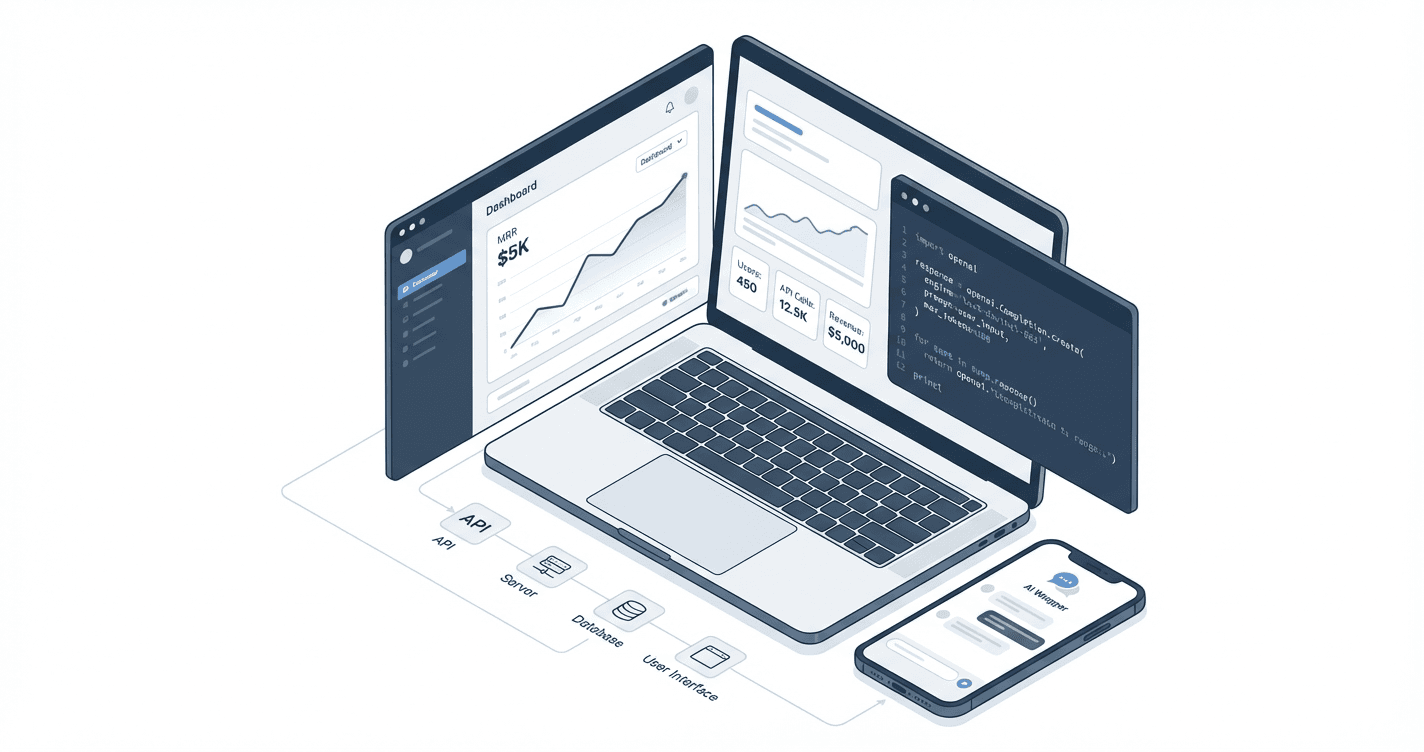
You have the coding skills and a dozen half-finished project ideas collecting dust in Notion, but every SaaS you start dies the same death: zero customers, zero revenue, back to the day job. While you're stuck overthinking your next move, developers with less talent are shipping AI wrappers and posting their first revenue screenshots in indie hacker communities. This course is the exact 60-day system to go from OpenAI API to your first paying customers--no VC funding, no team, just you and a repeatable playbook that turns your technical skills into recurring revenue.
What Students Say
Hear from learners who have completed this course:
Tomás R.
Product Analyst (Fintech) → Indie Micro‑SaaS Founder
I’d been “building in public” for months and still had zero paying users. Section 2 (high‑intent niche discovery) was the turning point—using the validation checklist and the outreach scripts, I interviewed 14 compliance and ops folks in small fintechs and found a consistent pain: turning policy PDFs into audit-ready control checklists. Section 3 helped me package it as an offer *before* I built anything (a narrow ‘policy-to-controls generator’ with export formats they already used). After shipping the MVP wrapper from Section 4, I implemented auth + usage tracking + rate limits exactly like Section 5 lays out, which stopped me from getting burned by heavy users on day one. The Stripe metered billing setup in Section 6 was straightforward and I iterated pricing twice using the course’s framework. Result: 11 customers in 7 weeks and $1.9k MRR—my first real revenue from a side project, and now my day job is letting me lead an AI initiative because I can speak concretely about metering, costs, and retention.
Read more
Adaeze O.
Customer Support Operations Lead (B2B SaaS)
I’m not a developer, but I work with engineering daily and wanted to launch an internal tool that reduced repetitive support work. The “Wrapper, But Valuable” positioning in Section 1 helped me stop thinking ‘chatbot’ and start thinking ‘workflow.’ I built a micro‑SaaS-like internal app that drafts replies *and* pulls the right policy snippets + links based on ticket tags (Section 4’s UX/differentiation guidance was huge here). The biggest win was Section 5: I finally understood API key management, rate limits, and usage tracking well enough to set requirements with our engineers—no more vague “just make it safe.” We added per‑agent usage caps and logging, which let us roll it out without finance panicking about API spend. Concrete results: average first-response time dropped from 3h 10m to 1h 55m, and our team’s macro library maintenance basically disappeared because the prompts + templates are versioned. I also used Section 8’s retention/support/analytics ideas internally: we added a simple feedback loop inside the tool and saw adoption climb from 40% to 78% of agents in a month.
Read more
Fatima A.
Freelance Full‑Stack Developer (React/Node)
This course is the reason I finally shipped something that people actually pay for. Section 3 (offer design) made me write a single-page ‘who it’s for / what it replaces / what outcome’ offer instead of a feature list. I targeted real estate photographers who need fast listing descriptions and alt text, and Section 2’s validation process helped me confirm they’d pay for bulk workflows—especially the CSV upload and brand-voice presets. In Section 4, the MVP wrapper guidance pushed me to build the differentiators (templates + guardrails + exports) instead of “ChatGPT with a login.” Implementing Stripe billing and metered usage in Section 6 was the missing piece—I was scared of pricing, but the iteration steps helped me land on a base plan + per‑listing overages. The launch playbook in Section 7 (Reddit/community outreach and landing page structure) got me my first customers without ads. Result: 23 paying users in 60 days, ~$3.4k MRR, and—most importantly—predictable usage costs because I set rate limits and tracked tokens from day one. I’ve already started a second wrapper using the same system.
Read more
Course Overview
Launch a focused AI-powered micro-SaaS in 60 days using a revenue-first system built for employed developers who want real traction, not another half-finished side project. You'll validate a high-intent niche, ship a narrow product that beats generic ChatGPT workflows, implement billing and usage controls, and execute a repeatable launch playbook to reach your first paying customers and scale toward $5K MRR.
Section 1: The 60-Day Game Plan and "Wrapper, But Valuable" Positioning
Set your scope, constraints, and definition of "done" so you can ship fast without becoming another generic AI tool. You'll also learn how to handle the AI-wrapper stigma by building ethical, defensible value around a specific workflow, audience, and outcome.
Learning Outcomes:
- Create a realistic 8-week sprint plan (8-12 hours/week) with clear deliverables and milestones
- Define your product's "unfair advantage" beyond prompts (workflow, UI, data, integrations, compliance, speed)
- Write a positioning statement that pre-empts common objections and clarifies why users should pay
You are a developer with a hard drive full of unfinished side projects. You have the technical skills to build almost anything, but you likely struggle with the two things that actually generate revenue: finishing and selling.
You are not alone. Industry benchmarks suggest that while technical founders ship code 40% faster than non-technical founders, they are 50% less likely to reach $10K MRR because they prioritize architecture over audience.
This course is not about learning to code; you already know how to do that. It is about unlearning the perfectionism that keeps you broke and learning the constraints that make you profitable.
In this first section, we are going to define exactly how you will spend the next 60 days. We will also dismantle the "AI Wrapper" stigma so you can build with confidence, knowing exactly where your product's value lives--and it isn't in the OpenAI API key.
The 60-Day Sprint: A Realistic Roadmap
Most developers fail because they treat a SaaS product like a hackathon project (built in a weekend, abandoned on Monday) or a corporate enterprise application (over-engineered, launched in 12 months).
We are aiming for the middle ground: a 60-day sprint executed alongside your full-time job. This requires 8-12 hours per week. If you cannot find that time, you cannot build a business.
Here is the high-level roadmap we will follow:

| Phase | Duration | Focus | Definition of Done |
|---|---|---|---|
| 1. Validation | Weeks 1-2 | Problem Discovery | A validated niche and a waiting list of 10+ people. |
| 2. The MVP | Weeks 3-5 | Core Feature Build | A functional tool that solves one specific problem. |
| 3. Infrastructure | Week 6 | Payments & Auth | Stripe connected, users can sign up and pay. |
| 4. Distribution | Weeks 7-8 | Launch & Marketing | First 10 paying customers. |
Key Insight: Notice that "The MVP" is only three weeks. If you cannot build the core value proposition in 30 hours of coding, the scope is too big for a solo founder. You are building a painkiller, not a vitamin.
The "Wrapper" Stigma: Why You Should Ignore It
If you spend time on Twitter or Hacker News, you have seen the criticism: "It's just a ChatGPT wrapper. Why would I pay for this when I can use the free web interface?"
This objection terrifies developers. It makes you feel like a grifter. However, this criticism fundamentally misunderstands how B2B software works.
Dropbox is just a wrapper around AWS S3. Jasper.ai started as a wrapper around GPT-3 and hit a $1.5B valuation.
Businesses do not pay for "AI"; they pay for workflow.
A raw LLM (Large Language Model) is a general-purpose engine. It is messy, requires perfect prompting, and doesn't integrate with other tools. Your job is not to build a better engine; your job is to build the car that gets the user from Point A to Point B safely and quickly.
The "Thick Wrapper" Strategy
To avoid building a "thin" wrapper that provides no value, you must build a "thick" wrapper. This means wrapping the AI model in layers of proprietary value that a generic chat interface cannot replicate.
Your Defensible Value Stack:
- Context Injection: The AI doesn't know your customer's private data. If your app securely ingests their PDF contracts, Notion databases, or Jira tickets and feeds relevant context to the LLM, you have created stickiness.
- UI/UX Specialization: Chat is a terrible interface for many tasks. If you are building an AI code reviewer, a GitHub bot interface is superior to a chat window. If you are building an AI interior designer, a drag-and-drop canvas is superior to text.
- Prompt Engineering as IP: Your users don't know how to chain prompts to get complex outputs. Your "secret sauce" is the backend logic that chains three different prompts together, validates the output, and formats it as a downloadable JSON or PDF.
- Integration & Action: ChatGPT gives you text. Your app should give you action. It shouldn't just write the email; it should draft it in Gmail.
Pro Tip: If your product is just a text box where the user types a prompt and gets an answer, you are in the "Kill Zone"--OpenAI will eventually release a feature that kills your product. If your product connects to a database, creates a specialized file format, or integrates with a third-party API, you are building a defensible business.
Defining Your Scope: The "No" List
To hit the 60-day target, you must be ruthless about what you do not build. As a developer, your instinct is to build everything from scratch. This is fatal.
For this sprint, adhere to the "Buy vs. Build" rule: If it is not your core differentiator, do not code it.
The Strict "No" List for MVP:
- No custom authentication: Use Clerk, Supabase Auth, or NextAuth. Do not roll your own JWT handling.
- No custom billing logic: Use Stripe Checkout or Lemon Squeezy. Do not build your own invoice generation.
- No complex settings pages: Users can email you to change their email address.
- No dark mode: It doubles your CSS workload. Ship light mode first.
- No perfect test coverage: Write integration tests for the critical path (Sign up -> Pay -> Use Core Feature). Ignore the rest for now.
Your Positioning Statement
Before you write a single line of code in Section 2, you need to articulate exactly why someone should pull out their credit card. We will use a specific framework to preempt objections.
The "Wrapper+Value" Positioning Template:
"For [Target Audience] who struggle with [Specific Pain Point], [Product Name] is a specialized workflow tool that [Core Outcome]. Unlike generic AI tools like ChatGPT, we [Unique Technical/Workflow Advantage]."
Example:
- Bad Positioning: "An AI tool that writes SQL queries." (Why not just use ChatGPT?)
- Good Positioning: "For backend developers who struggle with debugging complex legacy databases, QueryFix is a specialized workflow tool that automatically scans your schema and generates optimized indexes. Unlike generic AI tools, we connect directly to your Postgres instance to validate queries against real execution plans before suggesting them."
Notice the difference? The second example creates immediate value through integration and validation--things ChatGPT cannot do.
What Comes Next
You now have a timeline, a philosophy on value, and a set of constraints. You know that you are not building a generic tool, but a specialized workflow that leverages AI as a component, not the whole product.
However, a plan is useless without a target. You cannot build a solution until you find a problem worth solving.
Coming up in Section 2: We will tackle the hardest part of the process--Niche Selection. I will show you how to use data (not gut feeling) to find "boring" vertical markets where customers are desperate for AI automation and willing to pay $50/month for it. We will move from "I have an idea" to "I have market verification."
Section 2: High-Intent Niche Discovery and Validation (No Guessing)
Find micro-niches where people already pay to solve a painful problem and where AI can provide a measurable improvement. You'll use a validation scorecard based on demand signals (search intent, existing spend, community activity) to pick a niche confidently.
Learning Outcomes:
- Generate 10-20 niche candidates using repeatable inputs (forums, job posts, SaaS directories, keyword tools)
- Validate demand with a scorecard (pain intensity, willingness to pay, urgency, competition, accessibility)
- Produce a one-page "Niche Brief" including ICP, job-to-be-done, success metric, and pricing anchors
Most developers start the SaaS journey backward. They find a new AI capability--like the latest GPT-4o vision features--and immediately think, "This is cool. What can I build with this?"
This approach leads to the "Solution in Search of a Problem" trap. You spend three weeks building a technically impressive wrapper that summarizes YouTube videos, only to realize that the market is flooded with free alternatives and your target users (students) have zero willingness to pay.
To reach $5K MRR, you must flip the equation. We do not start with the technology; we start with the pain.
In this section, we are replacing "brainstorming" with a systematic Input/Output process. Your goal is to identify micro-niches where purchasing intent already exists and then confirm that AI can offer a 10x improvement over the current manual solution.
The Input System: Where to Find Pain
Stop trying to "come up with ideas." Instead, look for evidence of expensive problems. We are looking for "High-Intent" signals--places where people are already exchanging money or significant time to solve a specific issue.
Here are three repeatable inputs to generate your initial list of 10-20 candidates:
1. The "Manual Labor" Audit (Upwork & Fiverr)
Go to freelance marketplaces and search for manual tasks that businesses pay for repeatedly. If a business pays a human $20/hour to do something, they will happily pay software $50/month to do it instantly.
- Search Queries: "Data entry," "Summarize," "Convert," "Extract," "Write description."
- The Signal: Look for jobs with high recurrence. "I need someone to take these 50 PDF invoices and put the data into Excel every Friday."
- The AI Wrapper Opportunity: An interface that accepts PDF uploads, uses the OpenAI Vision API to extract structured JSON, and exports a CSV.
2. The "SaaS Gap" Analysis (G2 & Capterra)
Find established, clunky software in boring verticals (Legal, HR, Construction, Logistics) and read the 2-star and 3-star reviews.
- The Signal: Users complaining about complexity or lack of specific features. "I love Salesforce, but I hate that I have to manually write follow-up emails based on the lead status."
- The AI Wrapper Opportunity: A vertical-specific plugin or standalone tool that handles just that friction point. "AI Follow-Up Writer for Salesforce Leads."
3. Community "How Do I" Threads (Reddit & Niche Forums)
Use site-specific Google searches to find people describing a workflow blocker.
- Query:
site:reddit.com "how do I automatically" "tedious" "takes forever" - The Signal: A thread in r/RealEstateAgents asking, "How do I write listing descriptions faster? It takes me an hour to sound creative."
- The AI Wrapper Opportunity: A form-based wrapper where agents input square footage and amenities, and the AI outputs a compliant, persuasive Zillow description.
Key Insight: You are not looking for "fun" ideas. You are looking for boring problems. The more boring the problem, the less competition you will face from indie hackers chasing the latest "AI Avatar" trend.
The Validation Scorecard
Once you have a list of candidates, you need to filter them ruthlessly. Most ideas feel good in the moment but fall apart under scrutiny. We use a 5-Point Validation Scorecard to quantify the potential of a niche before writing a single line of code.
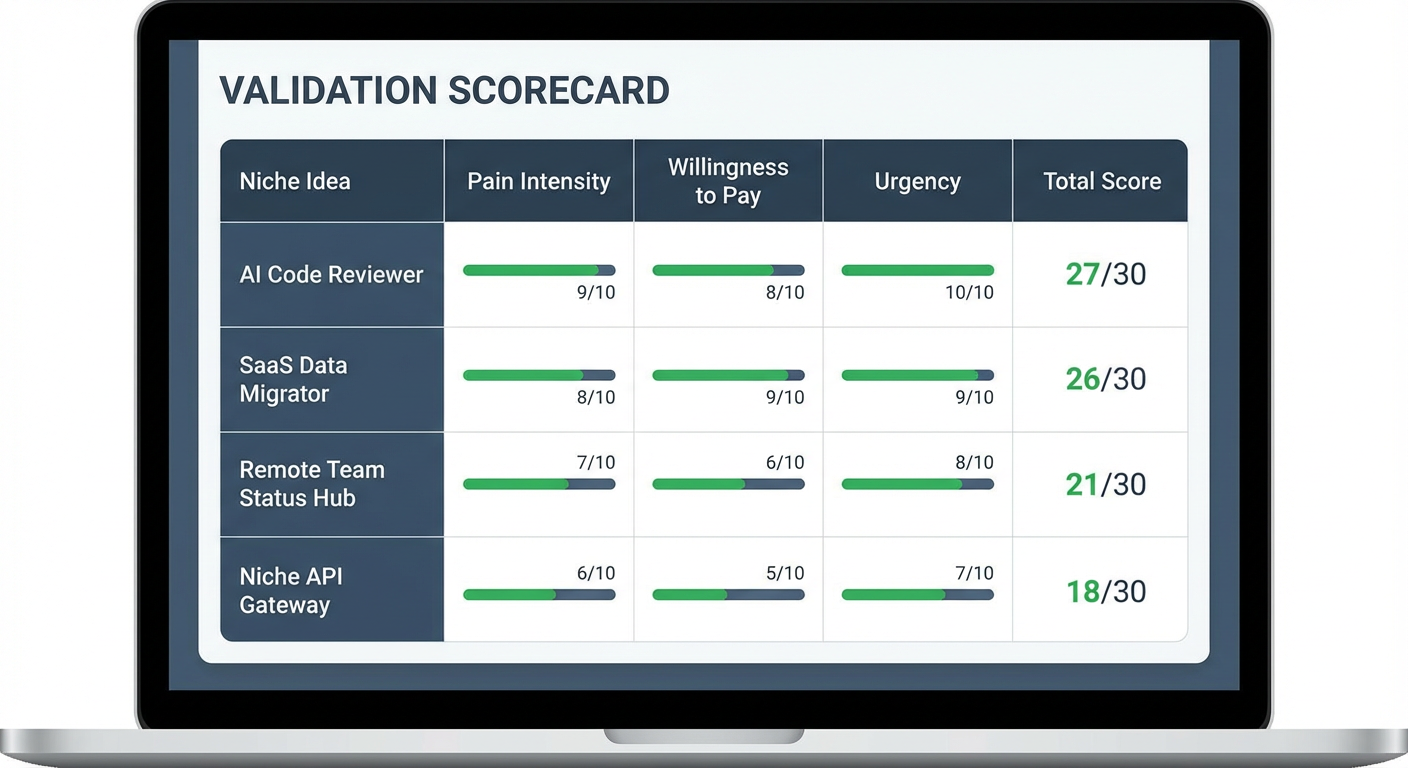
Assign a score of 1 (Low) to 5 (High) for each category. A total score below 18 is a "No Go."
| Criterion | What High (5/5) Looks Like | What Low (1/5) Looks Like |
|---|---|---|
| Pain Intensity | The user loses money or risks compliance issues if this isn't solved. | It is a "nice to have" convenience or entertainment. |
| Purchasing Power | B2B buyers, agencies, or high-income professionals. Expense account exists. | Students, hobbyists, or people looking for freebies. |
| AI Feasibility | The API can solve this with 90%+ accuracy right now. | Requires AGI, complex physical world context, or 100% perfect accuracy (e.g., medical diagnosis). |
| Search Intent | People search for "tool to [solve problem]" or " [competitor] alternative." | People don't know the problem exists or aren't searching for a solution. |
| Accessibility | You can reach these people via cold DM, forums, or ads. | Gatekeepers prevent access (e.g., selling to Government or Enterprise CIOs). |
Pro Tip: As a solo developer, pay special attention to Accessibility. You might find a massive pain point in "Hospital Bed Management," but if you cannot get a hospital administrator on the phone, the idea is dead. Stick to buyers you can reach online: other devs, creators, small agency owners, and freelancers.
Creating the "Niche Brief"
Once an idea passes the scorecard (score 18+), stop brainstorming and create a Niche Brief. This one-page document acts as your spec sheet. It prevents scope creep--the enemy of the 60-day timeline.
If you cannot fill out this brief clearly, you do not understand the niche well enough yet.
Example Niche Brief: The "RFP Responder"
- Target Audience (ICP): Small marketing agency owners (5-20 employees).
- The Trigger: They receive a Request for Proposal (RFP) PDF from a potential client.
- Current Workflow (The Pain): The founder spends 4 hours on Sunday reading the PDF, copy-pasting agency accolades, and writing custom answers. It is tedious and unbillable work.
- The Solution (The Wrapper): Users upload the RFP PDF and their "Agency Knowledge Base" (past successful proposals). The AI maps the questions to the knowledge base and drafts a response.
- Value Metric: Hours saved per proposal. (From 4 hours to 15 minutes).
- Pricing Anchor: $49/month (One hour of their time is worth $150+, so this is a "no-brainer").
- Keyword Demand: "RFP automation software," "proposal writing tools."
Why This Matters for the Build
The work you do here dictates the technical complexity required in Section 3. If you choose a high-pain B2B niche (RFP responses) rather than a low-pain B2C niche (AI horoscopes), the technical bar is different.
- For B2B: The UI can be utilitarian. Auth needs to be secure. The prompt engineering must be precise (no hallucinations allowed).
- For B2C: The UI must be flashy. Viral loops are needed.
By validating that the user is willing to pay $49/month, you have also validated that you can afford to use the more expensive, smarter models (like GPT-4 or Claude 3.5 Sonnet) rather than trying to optimize costs with cheaper models immediately.
What You'll Build On:
This Niche Brief is the foundation for the rest of the course.
- Section 3: You will use the "Solution" definition to determine your exact tech stack (Next.js vs. Python/Streamlit) and database schema.
- Section 4: You will use the "Pricing Anchor" to set up your Stripe products and subscription tiers.
- Section 5: You will use the "Target Audience" profile to write the copy for your landing page--speaking directly to their pain, not just listing features.
Moving From Research to Revenue
Most developers get stuck in the research phase forever. They create spreadsheets of ideas but never ship. In this course, we time-box this phase. You have one week to generate ideas, score them, and pick one.
It does not have to be the perfect "unicorn" idea. It just needs to be a valid idea.
The difference between a side project and a business is the validation of money changing hands. By selecting a niche where the "willingness to pay" is high and the "accessibility" matches your resources, you are stacking the deck in your favor.
This concludes the free preview of the course.
You now have a validated concept. The hard part--building a production-grade application that actually delivers on this promise--starts next.
In the full course, we stop planning and start coding. You will watch over my shoulder as we spin up a new repo, configure the OpenAI API for production (handling rate limits and context windows), and implement the payment infrastructure that turns users into revenue. We will also cover the "boring" but critical elements that kill most indie apps: legal boilerplates, customer support systems, and handling API costs.
If you are ready to stop guessing and start building a revenue-generating asset, the complete roadmap is waiting in Section 3.
Course Details
- Sections8 sections
- Price$9.99