From API Consumer to API Product Owner: Build and Monetize Your First Developer API in 60 Days
Build the skills and confidence to go from integrating other people's APIs to shipping and monetizing your own in 60 days, without quitting your job. You'll validate a niche with real developer demand, build a production-ready API with an opinionated stack, launch with paid plans, and execute a distribution playbook to reach your first paying customers and predictable monthly revenue.
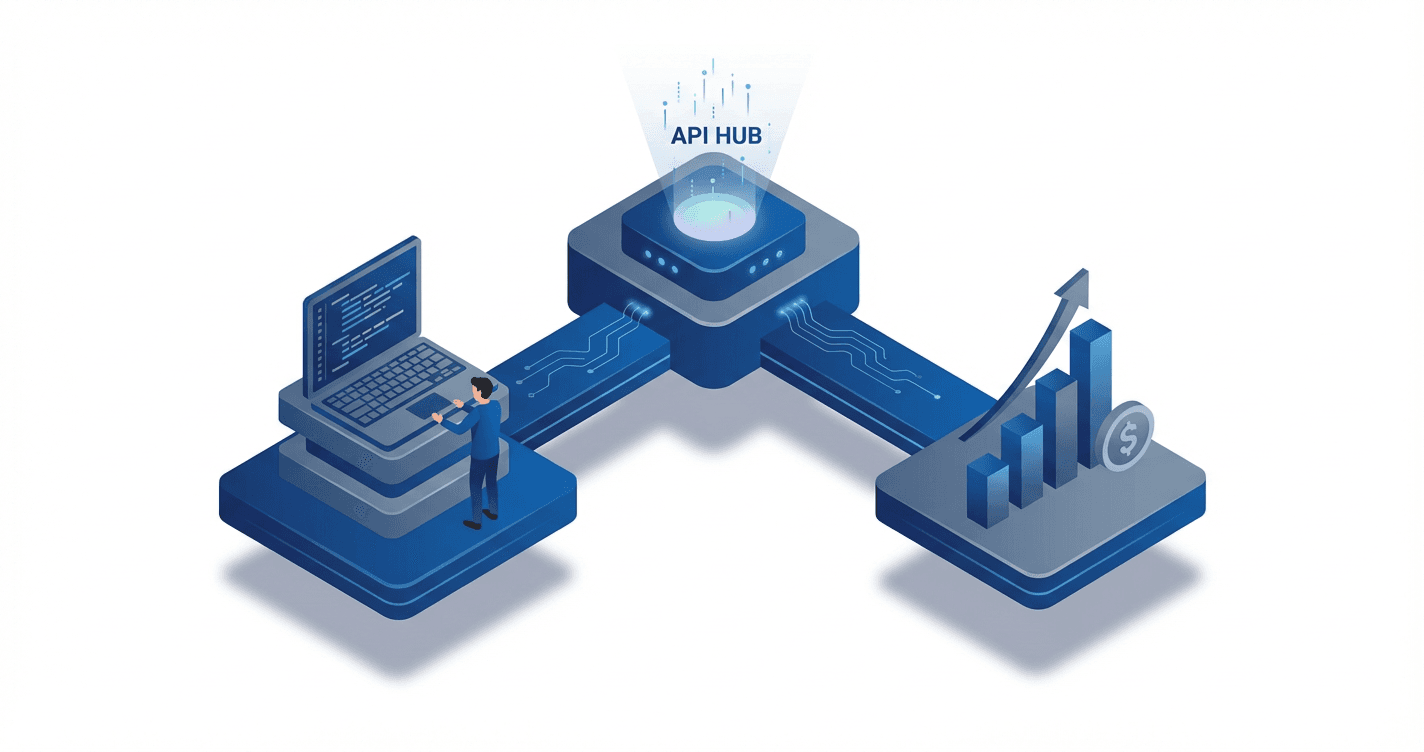
You've spent years integrating other people's APIs and making them rich--what if you built one developers actually paid to use? Most developer side projects die in a GitHub graveyard because you're missing the framework that turns technical skills into recurring revenue, not because you can't code. In 60 days, you'll go from another API consumer to someone collecting monthly payments from developers who need what you built.
What Students Say
Hear from learners who have completed this course:
Tomás R.
Senior Backend Engineer (Fintech)
I’d been an API consumer my whole career, but Section 1 (niche validation) was the first time I treated an API like a product. I used the “paid pain” checklist and the interview script to validate a small but urgent need: bank-statement normalization for LATAM accounting apps. Within two weeks I had 12 developer calls and a waitlist of 38. Sections 2–3 helped me avoid my usual ‘build everything’ trap—writing the contract first (error format, pagination, idempotency keys) made the FastAPI implementation straightforward. The biggest surprise was Section 5: I rewrote docs as an onboarding flow with copy-pastable curl examples and a Postman collection, and my support emails dropped from ~15/week during beta to 3–4/week after launch. I shipped a paid v1 in 7 weeks and hit $1,850 MRR by week 10 with three small SaaS customers on the Growth tier.
Read more
Adaeze O.
Product Manager, Developer Platform (B2B SaaS)
As a PM, I was comfortable writing PRDs but not translating them into an API product people will actually pay for. Section 2’s scope/contract and “DX as a feature” framing gave me a structure to run a real spec review with engineering—especially around versioning, rate limits, and a consistent error model. In Section 8, the roadmap and legal basics were immediately practical: I added a simple SLA, acceptable use language, and a deprecation policy that our legal team didn’t hate. The course’s launch and distribution playbook (Section 6) also changed how I talk to devs—my team started doing targeted ‘integration reviews’ with teams on GitHub and in niche Slack groups, which helped us close 9 paying customers in the first month for our internal API spun out as a paid product. Personally, it helped me move into a Dev Product Owner role; I now lead our API monetization roadmap and can speak confidently about pricing tiers and retention metrics.
Read more
Fatima A.
Data Scientist (E-commerce Analytics Consultant)
I consult on analytics, and clients kept asking for a ‘simple API’ to pull forecasted demand—something I’d always avoided because production and billing felt scary. Section 3 made it doable: I followed the Express path with the production fundamentals checklist (structured logging, environment config, basic auth/keys) and got a stable service running without overengineering it. Section 4 was the breakthrough—implementing metering + Stripe tiers (Free, Starter, Pro) forced me to define what the API is worth. I set limits by requests/day and added overage pricing, and Stripe webhooks now automatically upgrade/downgrade access. In Section 7, the monitoring and reliability lessons saved me: after adding health checks and alerts, I caught a memory leak before a client noticed. The concrete result: I replaced a one-off reporting retainer with recurring revenue—three clients are on paid plans now, and the API brings in about $1,200/month with far less back-and-forth than custom dashboards.
Read more
Course Overview
Build the skills and confidence to go from integrating other people's APIs to shipping and monetizing your own in 60 days, without quitting your job. You'll validate a niche with real developer demand, build a production-ready API with an opinionated stack, launch with paid plans, and execute a distribution playbook to reach your first paying customers and predictable monthly revenue.
Section 1: Choose a Niche That Pays and Validate It Fast
You'll identify API opportunities rooted in real developer workflows, then validate demand before building by running a lightweight customer discovery process and pre-selling access. The goal is to eliminate guesswork and prevent building a technically impressive API nobody buys.
Learning Outcomes:
- Use a niche scoring framework to generate and rank API ideas by urgency, willingness to pay, and reachability.
- Conduct fast customer discovery (DM scripts, forum outreach, short calls) and synthesize patterns into a clear problem statement.
- Produce a one-page API product brief: target user, "job to be done," MVP endpoints, pricing hypothesis, and launch criteria.
You are a developer who knows how to build. You have likely spent weekends configuring a Kubernetes cluster for a side project, obsessing over the perfect folder structure in a Go microservice, or evaluating four different ORMs before writing a single line of business logic.
But if you are like most engineers, you have a "GitHub Graveyard"--a collection of technically impressive private repositories that never made a dollar.
The reason isn't your code quality. It is the order of operations. In your day job, a Product Manager hands you a validated problem, and you execute the solution. In the indie API world, you must be the PM first, and you execute the solution. If you build before you validate, you are simply gambling with your time.
Key Insight: The most common cause of failure for developer-led products is not technical inability; it is building a solution for a problem that nobody is willing to pay to solve.
In this section, we are going to flip your usual workflow. We will identify high-value API niches, score them ruthlessly, and validate them--without writing a single line of backend code.
Source Ideas from "Boring" Workflows
Stop looking for "billion-dollar ideas" or the next Stripe. Instead, look for friction in professional workflows. As a developer, you have a superpower: you can automate the mundane.
The best API products often replace:
- Manual Data Entry: Humans moving data from email A to spreadsheet B.
- Brittle Scripts: Complex, unmaintained Python scripts that companies rely on but fear touching.
- Bloated Software: Enterprise tools where users only need 1% of the functionality via an endpoint.
To find these, analyze your current or past jobs. Where did the non-technical staff struggle? Did the marketing team manually resize images? Did the finance team manually scrape PDF invoices?
Once you have a list of potential problems, you need to rank them. Do not rely on your gut; use the Niche Scoring Framework.
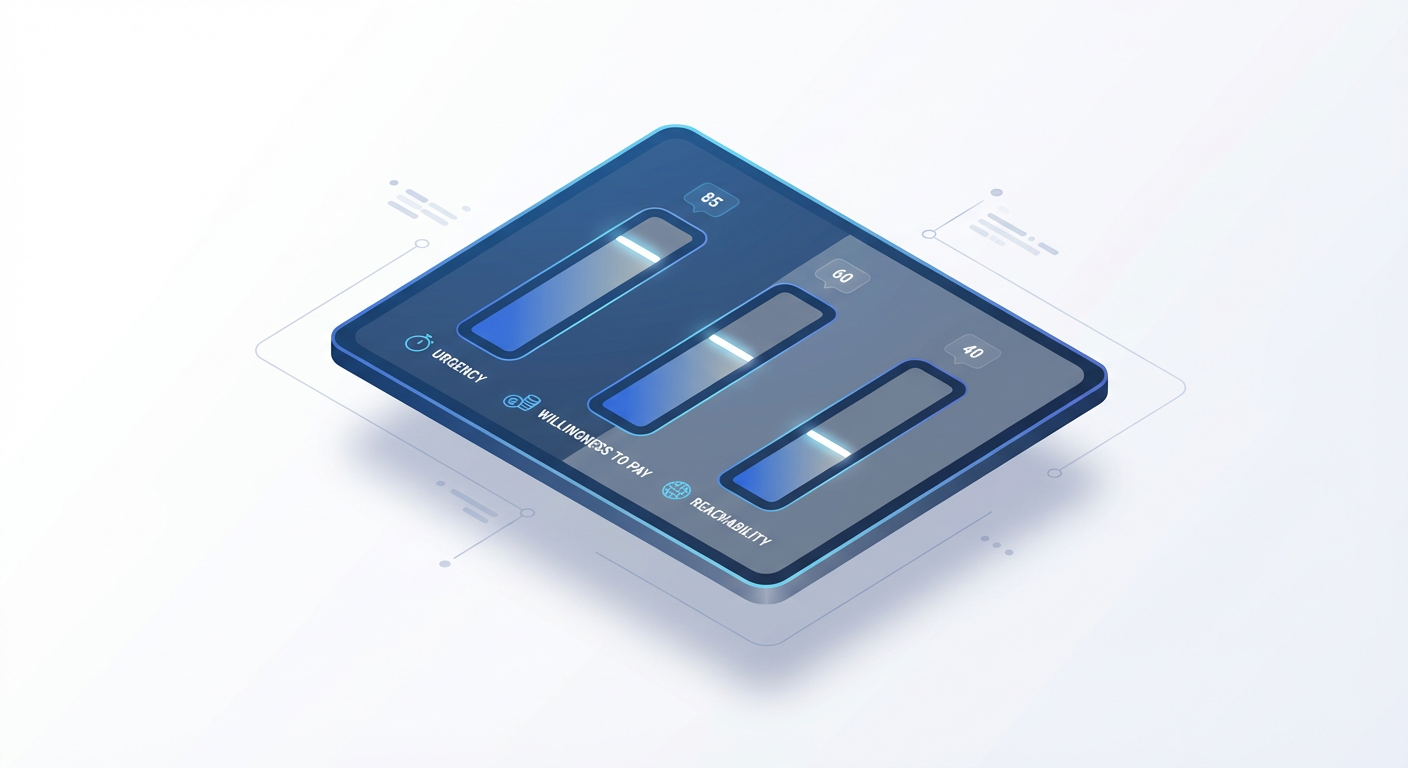
Score your ideas from 1 (Low) to 5 (High) on the following criteria. Be honest--especially about Reachability.
| Criteria | Definition | Why It Matters |
|---|---|---|
| Urgency | Is the user losing money or significant time right now without this? | Urgent problems sell themselves. Nice-to-have tools require expensive marketing. |
| Willingness to Pay | Does the target user have a budget? (B2B > B2C) | Selling to businesses ($50-$500/mo) is easier than selling to hobbyists ($5/mo). |
| Reachability | Do you know where these people hang out online? | If you can't find them in a forum, Discord, or LinkedIn search, you can't sell to them. |
| Technical Feasibility | Can you build an MVP in < 4 weeks? | If it requires 6 months of R&D, it's too risky for a solo founder. |
The Rule of 15: If an idea scores below a 15 total, discard it. If it scores high on Feasibility but low on Reachability (a common trap for devs), kill it immediately. You want an ugly idea you can sell, not a beautiful idea that lives in a vacuum.
The 48-Hour Validation Sprint
Once you have a high-scoring idea, you need to validate it. Do not start coding. Do not buy a domain name. Do not design a logo.
Your goal is to verify that the problem exists and that people are actively looking for a solution. You can do this through "Cold Outreach" or "Forum Intelligence."
The "Debugging" Approach to Outreach Developers hate sales, so don't "sell." Instead, frame your outreach as debugging a workflow. You are an investigator trying to understand a system failure.
Use this script for DMs on LinkedIn, Twitter/X, or Discord. It respects their time and appeals to their expertise:
Subject: Quick question about [Specific Workflow]

Hi [Name],

I'm a developer researching how [Job Title] handles [Specific Problem, e.g., parsing PDF invoices].

I'm considering building a simple API to automate this, but I want to make sure I'm not solving a problem that doesn't exist.

Could I ask you two quick questions via chat? I'm not selling anything--just trying to validate if this is worth building.

Thanks,
[Your Name]
If they reply, ask these two questions:
- "How do you currently handle [Problem]?"
- "Have you paid for any tools to try to fix this, or tried to build a workaround?"
Pro Tip: If they say "It's a problem," but they haven't tried to solve it (via spreadsheets, hiring someone, or buying software), it is not a painful enough problem to build a business around.
The One-Page Product Spec
After 5-10 conversations, you will see patterns. If the feedback is consistent ("Yes, this takes me 4 hours a week and existing tools are too expensive/complex"), you are ready to define the product.
Avoid scope creep by creating a One-Page API Product Brief. This acts as your "Definition of Done" for the MVP (Minimum Viable Product). If a feature isn't on this page, it doesn't get built in Section 2.
Your brief must include:
- The Hook: A one-sentence value prop. Example: "A REST API that converts PDF bank statements into normalized JSON."
- The User: Who is the developer integrating this? Example: Fintech backend engineers.
- MVP Endpoints: Limit this to the absolute minimum. Example:
POST /upload,GET /status/{id},GET /result/{id}. - Pricing Hypothesis: How will you charge? Example: Usage-based, $0.05 per page processed.
- Launch Criteria: What does "live" mean? Example: Stripe connected, Docs hosted, 3 beta users onboarded.
The Ultimate Validator: The Pre-Sale
The strongest signal of market demand is a credit card number. Before you write the backend logic, set up a simple landing page (Carrd or a simple HTML template) describing the API endpoints and outcomes.
Add a "Request Early Access" button that leads to a Stripe payment link for a small, one-time fee (e.g., $10 for lifetime early access) or a heavily discounted annual plan.
If nobody buys: You just saved yourself 60 days of coding. Go back to the scoring framework. If 3 people buy: You have concrete validation. You are now morally obligated to write the code.
Key Insight: Building a product gives you a sense of progress, but validation gives you a sense of direction. It is better to struggle for two weeks finding a niche than to struggle for two years maintaining a ghost town API.
What's Coming Next
You have now identified a niche that scores high on willingness to pay and reachability. You have a "Product Brief" that limits your scope to exactly what the customer needs. You have stripped away the fear of "will anyone want this?"
In Section 2: Architecting for Speed and Scale, we will open the IDE. We will take your Product Brief and translate it into a production-ready boilerplate. We won't just write routes; we will set up the authentication, rate limiting, and structure that allow you to go from "Hello World" to "First Payment" in record time. Let's build.
Section 2: Design the API Product: Scope, Contract, and Developer Experience
You'll translate your validated problem into a tight MVP scope and a clean API contract, choosing REST patterns, error conventions, pagination, and versioning that support long-term maintenance and monetization. You'll also make key product decisions early (rate limits, quotas, and feature gates) to reduce later rewrites.
Learning Outcomes:
- Define an MVP endpoint set that can earn the first dollar while avoiding scope creep.
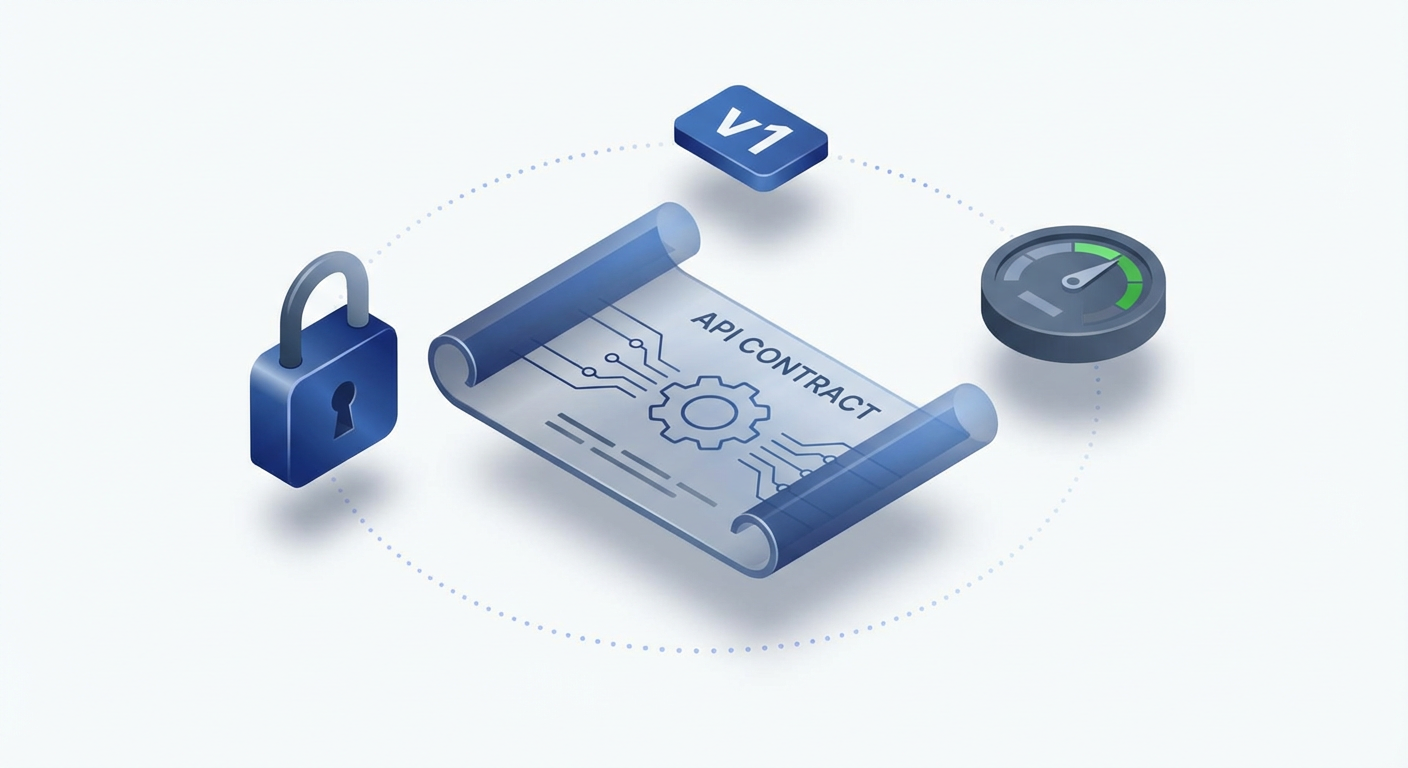
- Create an OpenAPI-first contract and standards for auth, errors, idempotency, pagination, and versioning.
- Decide on an initial packaging model (features vs usage limits vs both) aligned to the problem and expected customer behavior.
You have validated your niche. You know who the customer is and what problem you are solving. Now comes the most dangerous phase for a senior developer: The Build.
The temptation to over-engineer is overwhelming. In your day job, "production-ready" means microservices, 99.99% uptime, comprehensive test coverage, and a complex CI/CD pipeline. For a side-project MVP (Minimum Viable Product), "production-ready" means it works, it's secure enough, and it accepts credit cards.
In this section, we are going to design the product. We are not writing business logic yet. We are defining the contract--the interface between your backend and your future customer. This is where you prevent scope creep before it destroys your timeline.
The "One Resource" Rule for MVP Scope
Most developers start by listing every feature they might need. User management, team accounts, audit logs, complex filtering, password reset flows. If you build all of this, you will burn out in three months with zero revenue.
To launch in 60 days, you need to apply the One Resource Rule.
Your API should primarily revolve around one core resource that delivers the value.
- PDF Generator API: The resource is
Document. - Screenshot API: The resource is
Capture. - Sentiment Analysis API: The resource is
Analysis.
Your MVP scope should strictly be limited to CRUD (Create, Read, Update, Delete) operations on this single resource, plus the absolute minimum authentication.
Pro Tip: Do not build a frontend dashboard for your users in the MVP phase if you can avoid it. Use a simple static page for documentation and payment links. Developers are comfortable managing API keys via a simple CLI or a minimal portal. Every hour spent building a React dashboard is an hour not spent on the API that actually makes money.
Designing the Contract: OpenAPI First
Don't write code yet. Open a YAML file.
We are going to use Schema-Driven Development. By defining your API using the OpenAPI Specification (formerly Swagger) before you write a single line of Python or Go, you gain three massive advantages:
- Scope Enforcement: It is harder to accidentally add features to a YAML spec than it is to "just add one more function" in code.
- Free Documentation: Tools like Redoc or Swagger UI will generate your customer-facing documentation automatically from this file.
- Client Generation: You can eventually auto-generate SDKs for your customers.
The Decision Matrix: Standards vs. Creativity
Your business value lies in what the API does, not how the API works. Do not get creative with your API standards. Boring is profitable. Boring means less support tickets.
| Component | The "Creative" Trap (Avoid) | The Profitable Standard (Do This) |
|---|---|---|
| Authentication | Custom headers, IP whitelisting, signature hashing | Standard Authorization: Bearer <api_key> |
| Versioning | Header-based versioning, content negotiation | URI Versioning (/v1/resource) |
| IDs | Sequential Integers (1, 2, 3) | UUIDs or KSUIDs (prevents scraping, looks professional) |
| Response Format | Wrapping everything in {"data": ...} inconsistently | JSON API or simple, flat JSON objects |
| Errors | "200 OK" with error message in body | Standard HTTP Codes (400, 401, 429, 500) |
Error Handling as User Experience
In a developer product, your error messages are your UI. If a developer integrates your API and gets a generic 500 Internal Server Error, they will churn. If they get a clear message explaining exactly what they did wrong, they will fix it and pay you.
Adopt the RFC 7807 (Problem Details for HTTP APIs) standard immediately. It provides a consistent structure for machine-readable errors.
Bad Error Response:
{
  "error": "Invalid input"
}
High-Value Error Response (RFC 7807):
{
  "type": "https://api.yourservice.com/probs/validation-error",
  "title": "Invalid Parameters",
  "status": 400,
  "detail": "The 'format' parameter must be one of: pdf, png, jpg.",
  "instance": "/v1/captures/12345"
}
This tells the developer exactly how to fix the problem without emailing your support address.
Packaging: Rate Limits and Quotas
You need to decide how you will charge. In the API world, your code architecture is your billing model. You are not just preventing DDoS attacks; you are defining your product tiers.
Key Insight: Features don't usually drive upgrades in the early days; usage volume does. A developer will pay $29/month not because they need "Team Access," but because they need 1,000 requests instead of 100.
The Three-Tier Model
For your MVP, stick to a simple tiered limit strategy. This avoids the complexity of metered billing (charging per request) which makes Stripe integration significantly harder.
-
Hobby (Free/Trial):
- Rate Limit: 1 request per second (prevents abuse).
- Quota: 100 requests per month.
- Goal: Let them verify that it works.
-
Pro ($29-$49/mo):
- Rate Limit: 10 requests per second.
- Quota: 10,000 requests per month.
- Goal: Capture the serious individual developer or early-stage startup.
-
Scale ($99-$149/mo):
- Rate Limit: 50 requests per second.
- Quota: 100,000 requests per month.
- Goal: Capture production workloads.
Implementation Note: When designing your API contract, you must decide how to communicate these limits. The industry standard is returning headers with every response:
X-RateLimit-Limit: The total limit.X-RateLimit-Remaining: Requests left in the current window.X-RateLimit-Reset: Timestamp when the window resets.
If you don't design these headers into your scope now, adding them later will require refactoring your middleware and updating documentation--maintenance work you can't afford when you're trying to grow.
Building the Developer Experience (DX)
Your "Developer Experience" is the sum of how easy it is to perform the "Hello World" of your API.
The 5-Minute Rule: A developer should be able to land on your docs, get an API key, and make a successful cURL request in under 5 minutes. If it takes longer, they will close the tab and go to a competitor.
To ensure this in your design phase:
- Eliminate Async where possible: If your process takes 2 seconds, just keep the connection open. Don't force them to poll a webhook for the result unless it takes longer than 10 seconds. Webhooks kill the "time-to-first-hello-world" speed.
- Default everything: Optional parameters should always have sensible defaults. A
POST /screenshotendpoint should work with only a URL. Don't make them specify viewport size, format, and delay just to test it.
Your Deliverable for This Section
By the end of this week, you should have a single openapi.yaml file. This file represents your business promise.
- It defines exactly 3-5 endpoints.
- It specifies the security scheme (Bearer Auth).
- It defines the error schemas.
- It is strict enough that you can start coding the backend immediately without "guessing" what the frontend needs.
This contract is your shield against scope creep. If a feature isn't in the YAML, it doesn't get built in the MVP.
What You'll Build On
This design phase is the foundation for the rest of the course. Here is how your API Contract connects to future sections:
- In Section 3 (The Build), we will use this OpenAPI spec to auto-generate server stubs and client validation libraries, saving you 20+ hours of coding.
- In Section 4 (Monetization), we will map the rate limits you defined here directly to Stripe Products using a specific webhook logic that handles upgrades automatically.
- In Section 6 (Marketing), this contract becomes the source for your "Interactive Docs," a key marketing asset that lets developers try your API without writing code.
Ready to Build the Engine?
You have a validated problem and a tight, professional blueprint. Now comes the execution.
In the full course, we move from planning to production. We stop talking about theory and start writing the code that processes payments and serves requests.
Coming up in the full course:
- The "Boilerplate-Free" Stack: A specific, opinionated tech stack (Python/FastAPI or Node/Express) optimized for solo founders.
- Stripe Integration Deep Dive: Not just how to accept payments, but how to handle failed cards, pro-rating upgrades, and tax compliance without hiring an accountant.
- The "Zero-Marketing" Launch: How to get your first 10 customers by leveraging developer communities, not by buying ads.
- Legal & Liability: What you actually need in your Terms of Service to protect your personal assets if your API goes down or is misused.
You have the design. Now let's build the business.
Course Details
- Sections8 sections
- Price$9.99