Crack the Code: Land Your Dream Tech Job with Insider Interview Strategies in 45 Days
Crack the Code is a prescriptive 45-day interview system designed for busy developers who want FAANG-level offers without drowning in endless resources. You'll follow a day-by-day plan to master algorithm patterns, system design, behavioral storytelling, and real interview execution, then package it all with a recruiter-ready resume, targeted networking, and negotiation tactics to maximize total compensation.

You've been grinding LeetCode for months, but you're still getting rejected by Google, Meta, and Amazon while watching less experienced developers walk into six-figure offers. The problem isn't your coding skills--it's that you don't know the actual playbook that interviewers use to evaluate candidates, the specific patterns that top companies test for, or how to turn your experience into answers that make hiring managers fight to recruit you. In the next 45 days, you'll learn the exact system that has helped over 3,000 developers turn interview anxiety into multiple competing offers, often doubling their compensation in the process.
What Students Say
Hear from learners who have completed this course:
Tomás U.
Backend Engineer (FinTech)
I was stuck in “random LeetCode” mode for months and still blanked in interviews. Section 1’s 45‑day plan forced me to baseline honestly (timed medium problems + a system design prompt) and then follow the day-by-day schedule. The biggest unlock was Section 3’s pattern mastery—especially sliding window, two pointers, and BFS/DFS templates. I went from taking 45–60 minutes to finish mediums to consistently finishing in ~25–30 minutes with cleaner explanations. Section 2’s scoring breakdown also made me narrate tradeoffs instead of just coding. Result: I passed two onsite loops (one included a graph + top-k variant that matched the pattern drills) and got a backend offer that was ~$38k higher than my previous role. The structure kept me from over-studying and actually improved my performance under time pressure.
Read more
Adaeze N.
Data Scientist (Healthcare Analytics)
My weak spot wasn’t coding—it was behavioral. I kept sounding “technical but vague,” and I’d ramble. Section 5’s story bank + STAR framework (and the part about making STAR not sound scripted) changed everything. I built 10 stories mapped to common competencies, then practiced the “1-sentence headline + 3 bullets” delivery the course recommends. In Section 7, the mock interview feedback loop helped me notice I was skipping impact metrics, so I started leading with numbers (e.g., reduced model retraining cost by 22%, improved alert precision by 15%). Within three weeks, recruiter screens became noticeably smoother: I moved from 1 callback out of 5 to 4 out of 6. I ultimately landed a senior DS role where the hiring manager explicitly said my leadership stories were the clearest they’d heard from a candidate with my background. I also used Section 6 to tighten my resume—swapped task-y bullets for outcome + scope—and it immediately improved response rates.
Read more
Yasmin A.
Mobile Engineer (Android)
I was aiming for a mid-to-senior loop and system design was terrifying because I’d only done small app architectures. Section 4 made it concrete: capacity estimates, defining APIs, data model sketching, then iterating on bottlenecks. I used the “whiteboard execution” checklist to design a notification delivery system and an image feed—both came up in variants during interviews. Section 6 also helped me target networking: I stopped sending generic messages and used the course’s outreach template tied to specific teams and projects, which got me three referrals in two weeks. Finally, Section 8’s negotiation strategy worked exactly as described—I turned one initial offer into two competing ones and negotiated an extra $25k in base plus more RSUs by anchoring and timing the conversation properly. I didn’t just get an offer; I felt in control of the process for the first time.
Read more
Course Overview
Crack the Code is a prescriptive 45-day interview system designed for busy developers who want FAANG-level offers without drowning in endless resources. You'll follow a day-by-day plan to master algorithm patterns, system design, behavioral storytelling, and real interview execution, then package it all with a recruiter-ready resume, targeted networking, and negotiation tactics to maximize total compensation.
Section 1: Build Your 45-Day Plan and Baseline (No More Guesswork)
You'll define your target roles and companies, diagnose your current interview readiness, and turn your available hours into a realistic 45-day schedule. This section eliminates analysis paralysis by mapping exactly what to study, how to practice, and how to measure progress.
Learning Outcomes:
- Create a personalized 45-day study calendar aligned to your weekly time budget and interview timeline
- Establish a baseline via timed assessments (coding, behavioral, and system design) and identify your top 3 gaps
- Set up an accountability system: tracking dashboard, weekly milestones, and pass/fail readiness criteria
Stop treating your interview preparation like a lottery ticket. The biggest reason talented developers fail to land offers at Google, Meta, or high-growth unicorns is not a lack of coding ability--it's a lack of strategy. You are likely spending hours grinding random LeetCode problems, hoping that exposure to enough questions will result in a passing grade.
That's the "Brute Force" method of interview preparation. It's inefficient, exhausting, and statistically unlikely to work against candidates who have operationalized their study time.
To move from a mid-level role to a top-tier position with a compensation package exceeding $150K, you must treat this 45-day period as a project to be managed, not a hobby to be dabbled in. This section is your project charter. We will strip away the anxiety of "what should I study today?" and replace it with a calculated, data-driven execution plan.
Step 1: Define Your Target Tier
Before you write a single line of practice code, you must define the battlefield. Different companies evaluate candidates differently. A preparation plan for a Series B startup differs significantly from a plan for Amazon or Netflix.
We categorize targets into three distinct tiers. You must decide today which tier is your primary goal, as this dictates your study ratio.
| Tier | Examples | Focus Areas | Interview Style |
|---|---|---|---|
| Tier 1 (The Giants) | Google, Meta, Apple, Amazon, Netflix | 60% Algo/DS, 30% System Design, 10% Behavioral | Highly standardized. Expect LeetCode Hard/Medium optimal solutions. "Bar Raiser" rounds are common. |
| Tier 2 (Hyper-Growth) | Stripe, Airbnb, Uber, Datadork | 40% Algo/DS, 40% System Design, 20% Practical Coding | Practical application focus. Often involve "take-home" style pairing sessions or deep architectural discussions. |
| Tier 3 (Enterprise/Tech-Adjacent) | Banks, Retail Giants, Non-Tech Fortune 500 | 50% Practical Coding, 25% Behavioral, 25% Tech Breadth | Focus on language proficiency (Java/Python specifics) and culture fit. Algorithms are usually LeetCode Easy/Medium. |
Key Insight: Most candidates fail Tier 1 interviews because they underestimate the System Design component. For a mid-level or senior role, perfect code will not save you if you cannot design a scalable backend. If you are targeting Tier 1 or 2, your 45-day plan must include dedicated architectural study.
Step 2: Establish Your Baseline (The Diagnostic)
You cannot improve what you cannot measure. Many developers avoid testing themselves because they fear the result. You must break this habit immediately. To create a realistic schedule, you need to know exactly how wide the gap is between your current skill level and the hiring bar.
This weekend, you will conduct a Mock Loop. This is a 2-hour simulation designed to expose your weaknesses. Don't pause the timer. Don't use an IDE with autocomplete. Use a simple text editor or a whiteboard.
The Diagnostic Protocol:
- Coding (45 Minutes): Select two "Medium" difficulty problems from LeetCode (one Array/String, one Tree/Graph). Your goal is to solve both with clean, compiling code.
- System Design (45 Minutes): Prompt: "Design a URL shortening service like Bit.ly." Sketch the high-level architecture, database schema, and API endpoints.
- Behavioral (30 Minutes): Record yourself answering: "Tell me about a time you had a technical disagreement with a coworker."
Scoring Your Baseline:
- Coding: Did you reach an optimal solution ($O(n)$ or $O(n \log n)$) without hints? If not, your algorithmic pattern recognition is the bottleneck.
- System Design: Did you discuss trade-offs (e.g., SQL vs. NoSQL, Consistency vs. Availability)? If you only drew boxes without explaining why, your architecture skills are theoretical, not practical.
- Behavioral: Watch your recording. Did you ramble? Did you clearly define your specific contribution?
Pro Tip: If you failed to produce working code for the Medium problems within 45 minutes, do not panic. This is normal. It simply means your plan must prioritize Pattern Recognition (Section 2) over Mock Interviews in the first 15 days.
Step 3: The 45-Day Operational Schedule
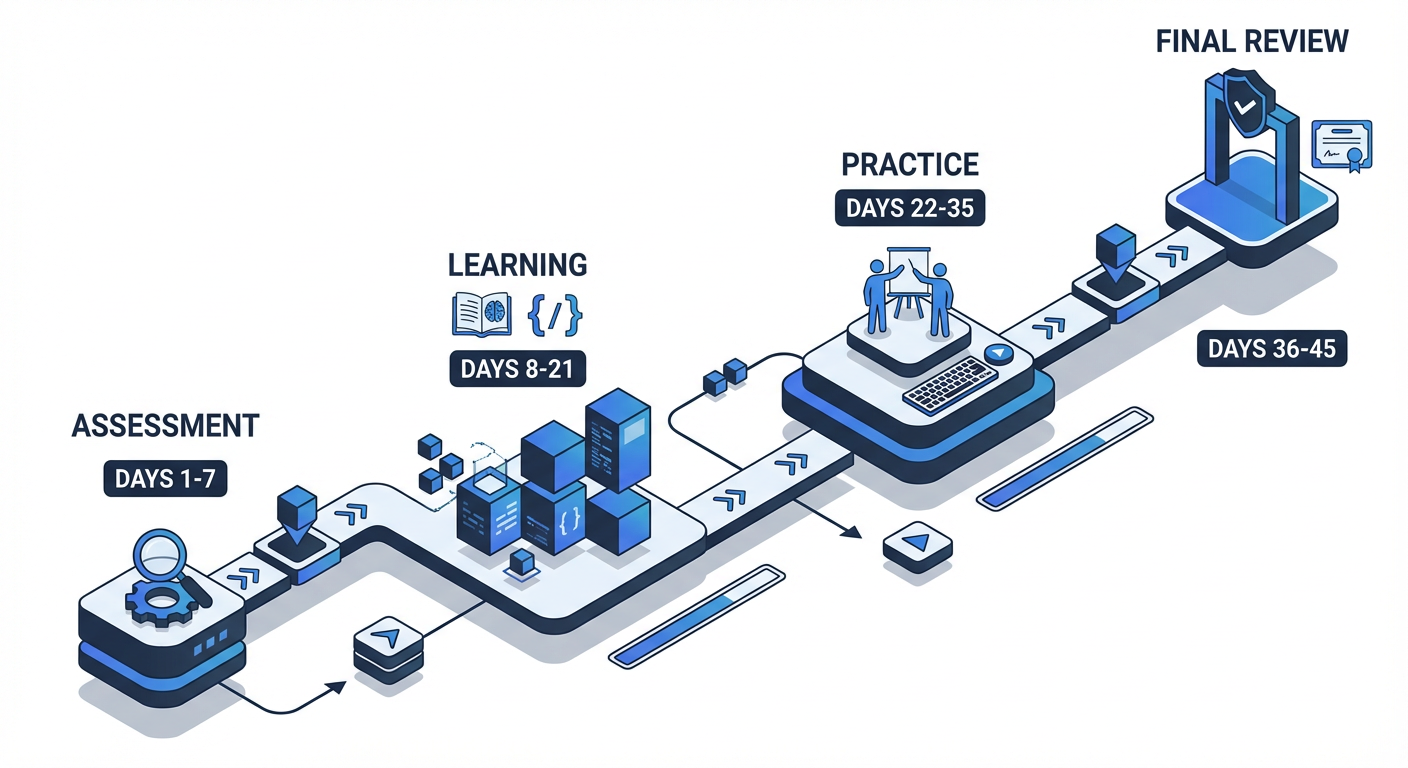
You have a full-time job. You likely have life commitments. Attempting to study 4 hours every weeknight is a recipe for burnout by Day 12. Instead, we use a "High-Intensity Interval" approach: consistent, focused blocks during the week, and simulation blocks on weekends.
Your time budget is 15 to 20 hours per week. This is the non-negotiable price of entry for a top-tier role.
Phase 1: Pattern Acquisition (Days 1-15)
- Goal: Stop solving problems; start recognizing patterns.
- Weekdays (1.5 hours/day): Focus on one data structure per 2 days (e.g., Arrays, HashMaps, Linked Lists). Don't solve random problems. Learn the 3 core patterns for that structure (e.g., Sliding Window, Two Pointers).
- Weekends (4 hours/day): Deep work on difficult concepts. Complete a "blind 75" set for the week's topics.
Phase 2: Competence & Design (Days 16-30)
- Goal: Speed and Scale.
- Weekdays (1.5 hours/day): Timed coding practice. You must finish a Medium problem in 20 minutes. If you fail, read the solution, write it out, and re-solve it the next morning.
- Weekends (5 hours/day): System Design deep dives. Study real-world architectures (Instagram, Twitter feeds). Read "Designing Data-Intensive Applications" summaries.
Phase 3: Simulation & Performance (Days 31-45)
- Goal: Interview Conditioning.
- Weekdays (1.5 hours/day): Behavioral stories (STAR method) and rapid-fire coding drills.
- Weekends (6 hours/day): Full mock interviews with peers or paid coaches. Pramp or Interviewing.io are excellent tools here. You need honest feedback on your communication style.
Step 4: The Accountability Dashboard
A calendar is not enough; you need a dashboard. Create a simple spreadsheet to track metrics that actually correlate with success. Don't track "hours studied." That is a vanity metric.
Track these KPIs (Key Performance Indicators):
- Pattern Fluency: Can you identify the optimal pattern for a new problem in under 2 minutes? (Pass/Fail)
- Implementation Velocity: Can you code a Bug-Free Medium solution in under 25 minutes? (Trend line should go down)
- Behavioral Bank: Number of "STAR" stories written, refined, and memorized. (Target: 6 stories mapping to Leadership, Conflict, Challenges, and Mistakes)
Important: Your readiness condition is consistency, not perfection. You are ready to apply when you can solve a random Medium problem optimally 80% of the time within 25 minutes, and can outline a System Design for a standard problem (e.g., Chat App) in 30 minutes without major logical gaps.
Looking Ahead
You now have a target, a baseline, and a schedule. You have moved from "hoping" to "executing."
However, a schedule is useless if you don't know how to study efficiently. Staring at a dynamic programming problem for three hours is a waste of time. In Section 2: Decoding the Algorithmic Patterns, we will dismantle the myth that you need to be a math genius to pass coding interviews. We will introduce the "Pattern-First" methodology that allows you to map 90% of LeetCode questions to just 14 core patterns, dramatically accelerating your Phase 1 progress.
Section 2: Coding Interview Fundamentals (How Interviewers Score You)
You'll learn the mechanics of high-scoring interview performance: problem clarification, constraints, tradeoffs, edge cases, complexity, and communication. The focus is not just solving, but solving in the way interviewers reward.
Learning Outcomes:
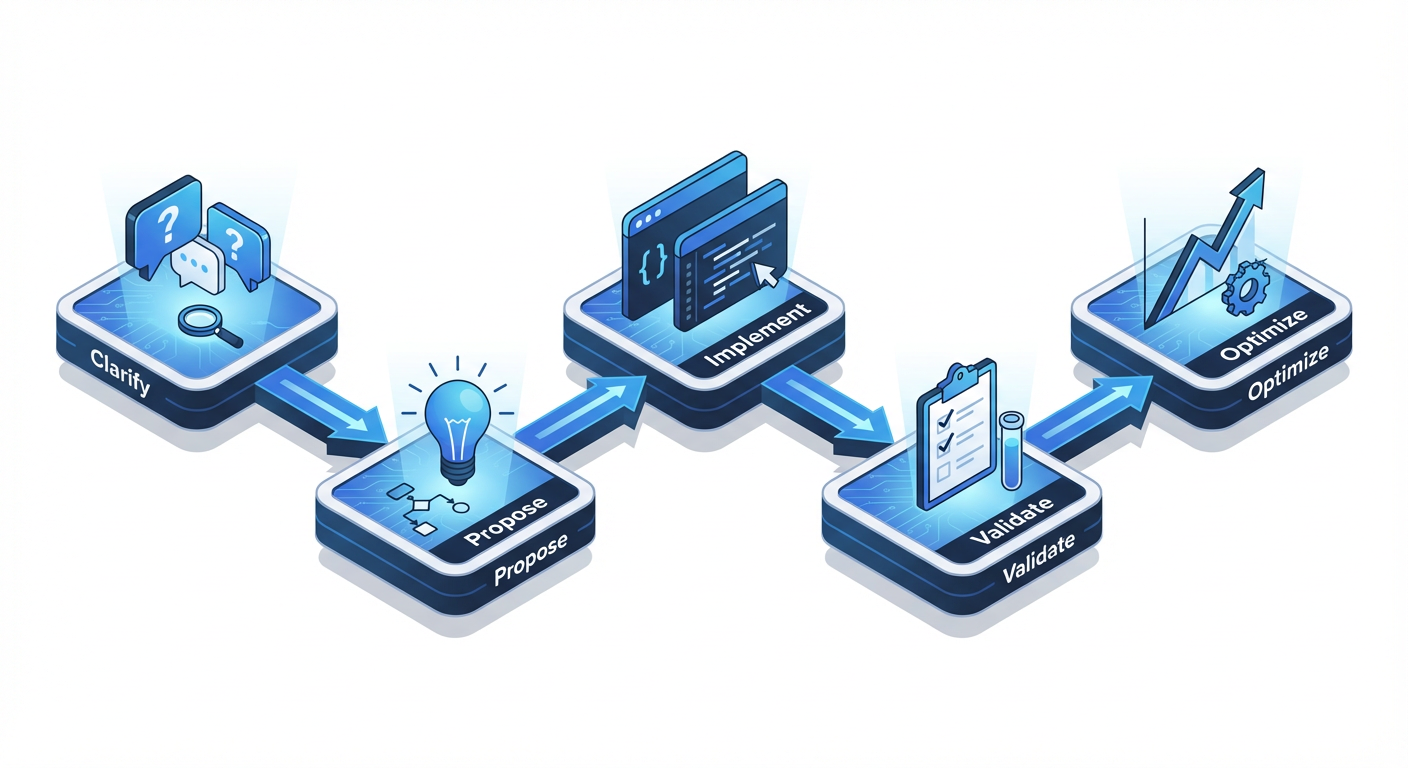
- Use a repeatable interview script (clarify, propose, implement, validate, optimize) under time pressure
- Avoid common failure modes: silent coding, missed edge cases, incorrect complexity, and premature optimization
- Apply a debugging and testing checklist that prevents "I had the right idea but failed" outcomes
You have your 45-day roadmap from Section 1. You know what to study. Now, we need to fix how you perform.
Most developers believe technical interviews are strictly about getting the right answer. This is a fatal misconception. If you solve a Hard LeetCode problem in 20 minutes but code silently, fail to check edge cases, or write messy "script-style" code, you will likely be rejected. Conversely, if you struggle with the optimal solution but demonstrate structured thinking, excellent communication, and strong debugging habits, you can often salvage a "Hire" or "Lean Hire" decision.
In this section, we are going to dismantle the "black box" of the interview process. We will replace panic-coding with a standardized, repeatable script that works whether you are interviewing at a Series B startup or Google.
The Interviewer's Scorecard
Before we get to the script, you need to understand how you are being graded. Interviewers at top-tier companies do not rely on "gut feeling." They fill out a specific rubric or scorecard immediately after you leave the room (or the Zoom call).
While the exact terminology varies among Meta, Amazon, and Microsoft, the core pillars remain identical. Your goal is to maximize points in four distinct buckets:
- Problem Solving: Can you translate an ambiguous prompt into a logical algorithm? Do you recognize patterns?
- Coding Implementation: Is your code syntactically correct, readable, and idiomatic? Do you use meaningful variable names?
- Verification (Testing): Do you find your own bugs, or does the interviewer have to point them out? Do you test edge cases?
- Communication: Can the interviewer follow your thought process? Are you receptive to hints?
Key Insight: A "silent solver" is an automatic fail. If the interviewer asks, "What are you thinking?" more than once, your communication score is tanking. You must narrate your decision-making process in real-time.
The 5-Step Interview Script
To maximize your score across all four pillars, you cannot improvise. You need a structured protocol. When the interviewer pastes the question, do not start typing code. Instead, execute this five-step script.
Step 1: Clarify and constrain (Minutes 0-3)
The prompt you receive will be intentionally vague. This is a test. The interviewer wants to see if you make assumptions or if you ask for requirements.
- Clarify Input/Output: "What should the function return if the input array is empty?"
- Establish Constraints: "Will the input fit in memory? What is the maximum value of N?"
- Identify Edge Cases: "Can the array contain negatives? Duplicates? Null values?"
Why this matters: If you assume an array is sorted when it isn't, you solve the wrong problem. If you assume N < 100 when N can be 10,000,000, your O(N^2) solution is useless.
Step 2: Propose and Discuss Trade-offs (Minutes 3-8)
Talk through your approach before writing a single line of executable code.
- Start with the Brute Force: Briefly acknowledge the naive solution to show you understand the basics. "We could compare every pair, which would be O(N^2)."
- Propose the Optimal Solution: "We can optimize this using a Hash Map to store complements, bringing time down to O(N)."
- Discuss Trade-offs: This is where senior engineers separate themselves from juniors. Acknowledge that your optimized solution uses more memory (Space Complexity) to save time.
Pro Tip: If you are stuck, explicitly state: "I'm thinking of a brute force approach, but I'm trying to see if I can use a greedy approach to optimize." This invites the interviewer to give you a hint without docking points.
Step 3: Implement (Minutes 8-25)
Only now do you write code. Your coding style must be production-grade, not competitive-programming grade.
| Junior Signal | Senior/FAANG Signal |
|---|---|
int x, int y, arr | currentIndex, targetSum, inputArray |
One giant main function | Modular helper functions (e.g., isValid()) |
| Silent typing | "I'm using a while loop here to iterate until..." |
| Messy indentation/formatting | Consistent style and structure |
Step 4: Validate (Minutes 25-30)
Do not say "I'm done" immediately after typing the last semicolon. This is the most common failure mode for candidates who "had the right idea."
Instead, say: "I'd like to run through a few examples to verify this."
Manually trace your code line-by-line with:
- A standard case (happy path).
- An edge case (empty input, single element).
- A tricky case (duplicates, negatives).
If you find a bug during this trace, it counts as a positive signal. It shows you are diligent. If the interviewer finds the bug for you, it counts against you.
Step 5: Optimize and Analyze (Minutes 30-35)
Finally, state the time and space complexity explicitly using Big O notation. Be precise.
- Bad: "It's pretty fast."
- Good: "This runs in O(N) time because we iterate through the list once. The space complexity is O(N) because in the worst case, we store every element in the hash map."
The "Silent Failure" Checklist
You can implement the script perfectly and still fail if you hit specific "red flags." These are behaviors that make interviewers nervous about hiring you, regardless of your algorithmic skill.
1. The Premature Optimizer You obsess over micro-optimizations (like bit shifting instead of dividing by 2) while ignoring the macro-algorithm.
- Fix: Get a working solution first. Optimize readability second. Micro-optimize only if asked.
2. The Argumentative Candidate You push back aggressively when the interviewer questions your logic.
- Fix: Treat the interview as a collaboration. If they ask, "Are you sure about that loop condition?", take the hint. They are trying to save you.
3. The "It Works on My Machine" Coder You write code that relies on specific libraries or compiler quirks not available in a standard whiteboard environment.
- Fix: Stick to standard libraries (STL for C++, Collections for Java/Python).
Practical Application: The "Pre-Flight" Check
In the heat of the moment, adrenaline makes you forget the script. To combat this, write down this acronym at the top of your scratchpad or whiteboard as soon as the interview starts:
C.P.I.V.A.
- Clarify (Inputs, Constraints)
- Propose (Algorithm, Trade-offs)
- Implement (Clean Code)
- Validate (Dry Run, Edge Cases)
- Analyze (Time/Space Complexity)
Glance at this acronym throughout the session. If you find yourself coding (I) before you have Clarified (C), stop and pivot back.
What You'll Build On
Mastering this flow is the foundation. In the upcoming sections, we will load this framework with high-leverage technical ammunition:
- Section 3: We will tackle the specific Data Structures that appear in 90% of FAANG interviews.
- Section 4: We will learn "The Patterns"--shortcuts like Sliding Window and Two Pointers that allow you to identify the optimal solution in seconds.
- Section 6: We will scale this up for System Design, applying the same structured thinking to distributed architectures.
Summary
The difference between a rejection and an offer is often not your raw coding ability, but your ability to package that ability into a format the interviewer can easily score. By adhering to the CPIVC script, you reduce the cognitive load of "what do I do next?" and free up your brain to focus on the logic of the problem itself.
You now have the mechanics of a successful interview. In the next section, we will begin filling your toolkit with the actual algorithms and data structures you need to survive the technical onslaught. Get ready to dive deep.
Course Details
- Sections8 sections
- Price$9.99